 listicle
Ethical Clothing Brands Like Everywhere Apparel: 2026 Guide
Table of Contents
- What Makes a Clothing Brand Truly Ethical?
- Quick Comparison: Top Ethical Clothing Brands
- Affordable Ethical Clothing: Quality Without the Premium
- Sustainable Streetwear Brands for Everyday Style
- How to Build a Sustainable Wardrobe That Lasts
- Care, Repair, and Resale: Extending Garment Life
- Conclusion: Your Next Ethical Purchase
- Frequently Asked Questions
Last Updated: September 30, 2026
What Makes a Clothing Brand Truly Ethical?
Ethical clothing brands are companies that build transparency, fair labor, and lower-impact materials into how garments are made, not just how they are marketed. This guide from RastaHippies.com breaks down what separates real ethical clothing brands from greenwashed labels, and where to shop in 2026.
The difference usually comes down to four things: who made the garment, what it is made of, whether the brand can prove both, and whether the clothes last. A brand that publishes its factory list, uses certified fibers like organic cotton or recycled polyester, and offers repairs or take-back programs is doing the work. A brand that only prints "eco" on a hangtag is not.
Below, we explain how to spot greenwashing and show how to build a wardrobe that holds up for years.
Federal Trade Commission Green Guides on environmental marketing claims
Quick Comparison: Top Ethical Clothing Brands
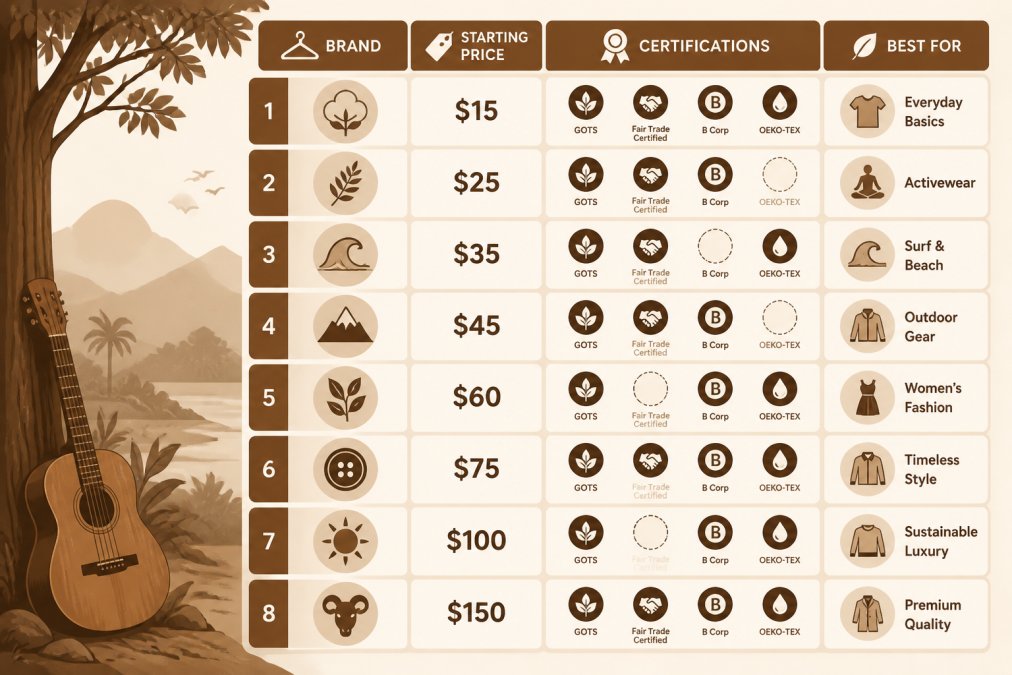
The table below compares eight established ethical clothing brands on starting price, key certification, and best use case. Prices reflect each brand's published entry-level items and are shown for reference only.
| Brand | Starting Price | Key Certification | Best For |
|---|---|---|---|
| Pact | $20 | GOTS, Fair Trade Certified | Affordable organic basics |
| Boody | $15 | OEKO-TEX | Soft base layers, sensitive skin |
| Everlane | $30 | GOTS organic cotton | Minimalist workwear staples |
| Outerknown | $40 | Fair Labor Association | Durable coastal casual wear |
| Patagonia | $45 | B Corp, recycled materials | Outdoor gear, repairs |
| Reformation | $48 | Climate-neutral operations | Trend-driven occasion wear |
| Eileen Fisher | $80 | Circular take-back program | Timeless investment pieces |
| Nudie Jeans | $150 | Organic cotton, free repairs | Long-life denim |
What Each Certification Actually Guarantees
A certification is only useful if you know what it audits. These are the four most common labels on ethical clothing and what each one verifies:
- GOTS (Global Organic Textile Standard): Covers the entire textile supply chain, from organic fiber farming through processing, and includes social criteria for workers. It is the strongest single guarantee that a garment's cotton is genuinely organic.
- Fair Trade Certified: Focuses on worker welfare at the factory or farm level, including verified wages, safe conditions, and a premium paid back to workers. It does not certify the fiber itself.
- OEKO-TEX: Tests finished textiles for harmful substances like heavy metals and formaldehyde. It is a safety standard, not a labor or environmental one, so a brand can hold OEKO-TEX while still using conventional cotton.
- B Corp: Audits a company's overall social and environmental performance, governance, and transparency. It says nothing about a specific garment's materials, so treat it as a company-level signal rather than a product-level one.
How to Read the Table
A brand can appear strong on price and still fall short on proof. Use the table as a starting filter, then verify two things before buying: whether the certification applies to the specific item you want (not just the brand overall), and whether the brand publishes a factory list or supplier map. A common pattern is that lower-priced entries carry a fiber certification but not a labor one, while higher-priced entries carry both. That gap is often the real reason for the price difference, not markup alone.
A Note on Sizing and Fit
One gap most brand roundups skip: ethical clothing has historically lagged on size inclusivity, and streetwear silhouettes are especially affected. Before committing to a brand, check whether its size range extends past a standard medium-to-large run and whether it publishes garment measurements rather than just body measurements. Brands that list flat-lay measurements make it far easier to judge fit without ordering multiple sizes and generating return shipping waste, which undercuts the environmental benefit of buying ethically in the first place.
Affordable Ethical Clothing: Quality Without the Premium
Affordable ethical clothing exists, but it rarely looks like fast fashion. The trick is buying fewer, better basics instead of chasing trends.
Affordable ethical clothing exists, but it rarely looks like fast fashion. The trick is buying fewer, better basics instead of chasing trends.
What most guides miss is that cost-per-wear matters more than sticker price. A $15 tee worn twice costs more per wear than a $40 tee worn eighty times. That math is what makes ethical clothing brands competitive over a year, not a single shopping trip.
Sustainable Streetwear Brands for Everyday Style
Sustainable streetwear brands blend urban style with ethical manufacturing, and the category has grown well past basic tees.
For anyone drawn to reggae, Rasta, and hippie culture, the aesthetic fit matters as much as the certification. RastaHippies.com unifies Reggae Rasta and Hippie cultures through original art and handcrafted merchandise, and donates to ocean and environmental conservation foundations including Bigger Than Waves, the Rob Machado Foundation, and Kōkua Hawaiʻi Foundation.
How to Build a Sustainable Wardrobe That Lasts
Building a sustainable wardrobe starts with a 30-item core and a one-in, one-out rule. That structure forces quality decisions and kills impulse buys. But the structure only works if you understand the math behind it, which is where most guides stop short.
The Cost-Per-Wear Math That Justifies Higher Prices
The single most useful habit for ethical shopping is calculating cost-per-wear instead of comparing sticker prices. The formula is simple: divide an item's price by the number of times you actually wear it.
A $15 fast-fashion tee worn five times before it pills or loses shape costs $3 per wear. A $40 organic cotton tee worn 80 times costs $0.50 per wear.
A Workable Approach
- List the 10 garments worn most often in the past month
- Identify gaps instead of wants
- Choose natural or recycled fibers: organic cotton, hemp fabric, Tencel Lyocell, recycled polyester
- Check for GOTS, Fair Trade Certified, or B Corp status
- Buy one piece at a time and wear it 10 times before buying again
- Track cost-per-wear quarterly
A capsule wardrobe built this way typically runs 30 to 40 pieces and covers most of the year. The goal is garment longevity, not restriction.
Care and Repair: The Post-Purchase Half Nobody Covers
Most articles focus entirely on buying. The higher-impact work happens after the purchase, and it costs almost nothing.
- Washing: Cold water and a shorter cycle reduce fiber breakdown. Heat is what shrinks cotton and degrades elastane in stretch fabrics.
- Drying: Air drying is the single biggest lever on garment lifespan. Dryer heat is responsible for a large share of the pilling and fading that sends clothes to donation bins early.
- Mending: Repair small damage early, a loose seam, a missing button, a small hole, before it spreads. Learning a basic running stitch and a button reattach covers most everyday repairs.
- Storage: Fold knits rather than hanging them to prevent shoulder stretch, and store natural fibers away from direct sunlight.
Second-Hand and Resale: The Circular Shortcut
The resale market is now a legitimate first stop, not a last resort. Buying second-hand sidesteps the manufacturing footprint entirely, and selling what you no longer wear recovers part of your original cost, which improves the cost-per-wear math further.
Environmental Protection Agency information on textile waste reduction
Care, Repair, and Resale: Extending Garment Life
Extending garment life is the highest-impact ethical choice available, and it costs nothing. Washing cold, air drying, and repairing small damage early can add years to a garment.
Environmental Protection Agency information on textile waste reduction
Conclusion: Your Next Ethical Purchase
Choosing ethical clothing comes down to proof, not promises. Verify certifications, check cost-per-wear, and favor brands that repair what they sell.
Frequently Asked Questions
What makes a clothing brand truly ethical?
A truly ethical brand prioritizes supply chain transparency, fair labor practices, and environmental responsibility. Look for certifications like Fair Trade Certified, GOTS organic cotton, and B Corp status. Brands should disclose factory locations, use low-impact dyes, and offer durable construction. Ethical brands also address garment worker welfare and reduce carbon footprint through sustainable sourcing and circular fashion initiatives.
Are there affordable alternatives to sustainable streetwear brands?
Yes, affordable ethical clothing exists. These brands keep prices accessible by focusing on core basics rather than trend-driven designs. Shopping second-hand or resale marketplaces also reduces costs while supporting circular fashion.
How can I verify if a clothing brand is actually sustainable?
Check for third-party certifications like Fair Trade Certified, GOTS, OEKO-TEX, or B Corp status. Visit the brand's website to see if they publish factory lists, environmental impact reports, or supply chain transparency details. Be wary of vague claims like 'eco-friendly' without specifics. Legitimate brands name their factories, explain material sourcing, and share measurable goals for reducing environmental impact.
What are the best materials for eco-friendly clothing?
Top eco-friendly materials include GOTS-certified organic cotton, Tencel Lyocell, recycled polyester, hemp fabric, and organic bamboo viscose. Organic cotton uses less water and avoids toxic pesticides. Tencel Lyocell comes from responsibly sourced wood pulp in a closed-loop process. Recycled polyester diverts plastic waste. Hemp requires minimal water and improves soil health.
Do ethical brands offer the same quality as conventional fashion?
Ethical brands often exceed conventional quality because durable construction supports garment longevity and reduces environmental impact. The higher upfront cost reflects ethical manufacturing, sustainable sourcing, and better materials, which translates to lower cost-per-wear over time compared to fast fashion.