 comparison
Wearpact vs Everywhere Apparel: Sustainable Clothing Comparison
Table of Contents
- Wearpact vs Everywhere Apparel: Quick Comparison Table
- Material Composition and Fiber Sourcing
- Organic Cotton Clothing Benefits: What You Actually Get
- Recycled Cotton Apparel Pros and Cons: The Trade-Offs
- Durability, Wash Performance, and Long-Term Wear
- Manufacturing Standards, Certifications, and Supply Chain Transparency
- Best Sustainable Clothing Brands: How These Two Fit the Landscape
- Frequently Asked Questions
Last Updated: September 26, 2026
Wearpact vs Everywhere Apparel: Quick Comparison Table
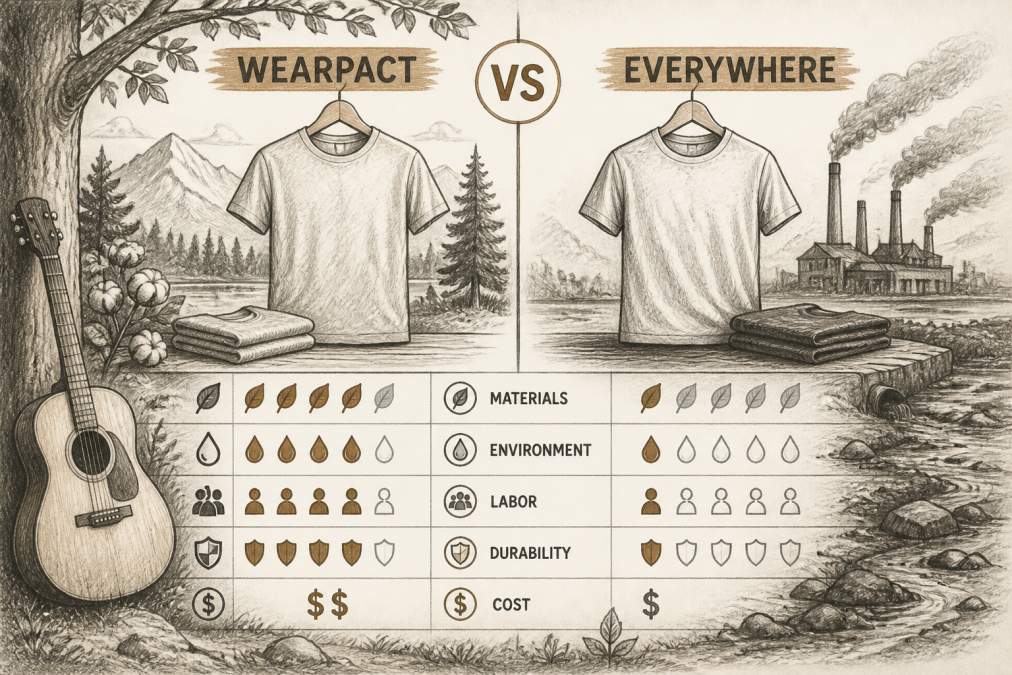
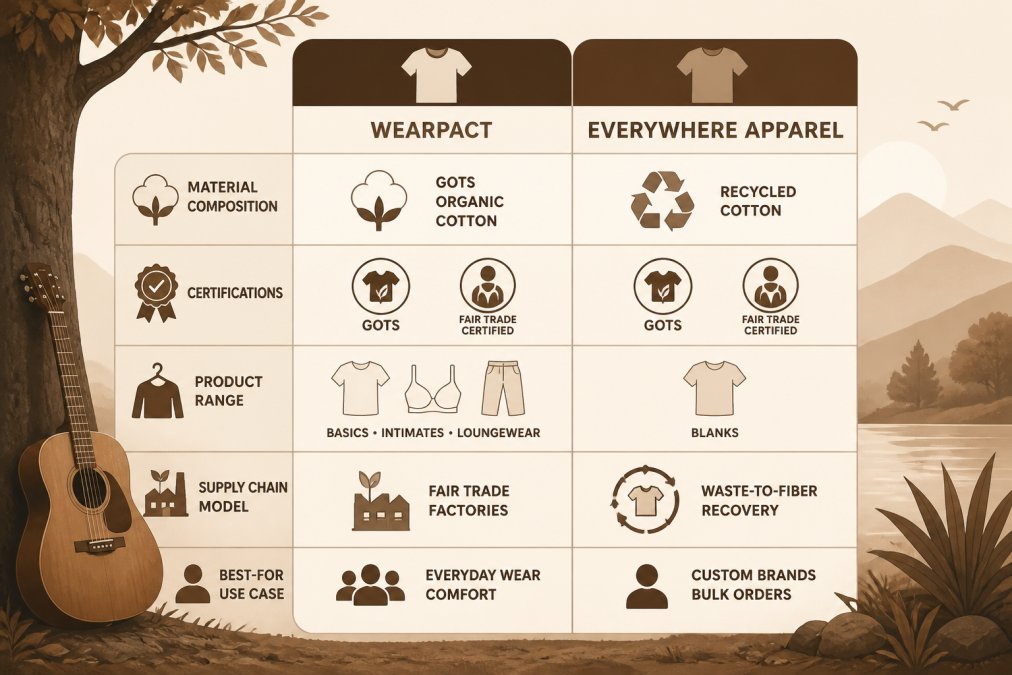
The wearpact vs everywhere apparel comparison comes down to two different answers to the same question: how do you make clothing that does less harm? Pact builds its line on GOTS-certified organic cotton and Fair Trade Certified factory partnerships. Everywhere Apparel takes a recycled cotton route, turning textile waste back into fiber. This guide from Rasta Hippies breaks down the materials, durability, and certifications behind each approach so the choice fits your values, not just a label.
| Factor | Pact | Everywhere Apparel |
|---|---|---|
| Primary fiber | GOTS-certified organic cotton | Recycled cotton from textile waste |
| Certification focus | GOTS, Fair Trade Certified | Recycled-content and circularity programs |
| Product range | Everyday basics, intimates, loungewear | Blanks and basics built for printing |
| Supply chain | Fair Trade factory partnerships | Waste-to-fiber recovery model |
| Best for | Organic basics and intimates | Circular-minded basics and blanks |
| Known trade-off | Some reports of inconsistent sewing quality | Recycled fiber can be shorter and weaker |
Material Composition and Fiber Sourcing
Fiber sourcing is where these two brands split. One grows new cotton under organic certification. The other recovers old cotton from textile waste.
Pact's GOTS-Certified Organic Cotton
Pact's core material is GOTS-certified organic cotton. The GOTS standard covers organic fiber content, restricted chemicals, and wastewater treatment across the supply chain. That matters because conventional cotton is a heavy pesticide and water user, and organic certification is one of the few claims a shopper can actually verify.
Everywhere Apparel's Recycled Cotton Approach
Everywhere Apparel starts from a different point: textile waste. Recycled cotton is made by shredding fabric scraps and worn garments back into fiber, then spinning it into new yarn. This keeps material out of landfills and cuts the demand for newly grown cotton.
Organic Cotton Clothing Benefits: What You Actually Get
Organic cotton clothing benefits show up in two places: how the fiber is grown and how it feels against skin. GOTS-certified organic cotton is grown without synthetic pesticides and processed with restricted chemical inputs, which reduces the toxic load on farmworkers and waterways. For the wearer, organic cotton tends to feel soft, breathe well, and avoid the chemical residue finishes common in conventional cotton.
- Softer hand feel that holds up over time
- Better breathability for everyday wear
- Lower chemical exposure for sensitive skin
- Verifiable certification rather than a vague claim
- Reduced pesticide and water impact at the farm level
Recycled Cotton Apparel Pros and Cons: The Trade-Offs
Recycled cotton apparel pros and cons come down to impact versus performance. On the plus side, recycled cotton diverts textile waste from landfills, uses less water and energy than growing new cotton, and supports circular apparel systems. On the minus side, the recycled fiber is often shorter and weaker, which can mean faster pilling, more shrinkage, and a need for blending to keep garments intact.
- Pro: keeps textile waste out of landfills
- Pro: lower water and energy footprint than virgin cotton
- Pro: supports circularity and textile recycling
- Con: shorter fibers can weaken yarn strength
- Con: higher risk of pilling and shrinkage
- Con: often blended with virgin fiber to compensate
Durability, Wash Performance, and Long-Term Wear
Durability is where recycled and organic cotton diverge most in daily use, and it is the single hardest thing to judge from a product page. Organic cotton fibers are longer and stronger, so GOTS basics generally resist pilling and hold their shape through repeated washing. Recycled cotton, made from shortened fibers, tends to show wear sooner unless it is blended for strength.
Side-by-Side Durability Profile
| Failure mode | GOTS organic cotton (Pact-style) | Recycled cotton (Everywhere Apparel-style) |
|---|---|---|
| Fiber length | Long staple, intact | Shortened by mechanical shredding |
| Pilling risk | Low to moderate | Moderate to high without blending |
| Shrinkage risk | Present if not pre-shrunk | Higher, fiber-dependent |
| Seam integrity | Construction-dependent | Construction-dependent |
| Color retention | Good with reactive dyes | Variable on recycled blends |
| Expected wear window | Multiple seasons with care | Shorter without virgin-fiber blend |
Shrinkage, Pilling, and Seam Integrity After Repeated Washes
Three failure points decide how a garment ages: shrinkage, pilling, and seam integrity. Organic cotton can still shrink if it is not pre-shrunk, so cold washing and low heat matter for both brands. Pilling shows up faster on recycled blends because short fibers work loose and ball up. Seam integrity depends less on fiber and more on construction quality, which is where user reports of inconsistent sewing on some Pact items become relevant.
- Fiber length retention. Long-staple organic cotton holds its twist; recycled fiber sheds short ends into pills.
- Pre-shrinking. Garments cut from pre-shrunk fabric move less than 2% in length; untreated cotton can move noticeably more.
- Stitch density and seam type. Flatlock and double-needle seams outlast single-needle overlock on high-stress points like shoulders and crotch.
The 6-Month and 1-Year Wear Timeline
Most reviews stop at unboxing. Here is what a realistic wear timeline looks like for each fiber route, based on how the materials behave under normal rotation:
- Month 1-2: Both feel comparable. Any shrinkage from the first wash shows up here.
- Month 3-6: Recycled blends begin to show surface pilling at friction points, underarms, waistband, inner thigh. Organic cotton stays smooth.
- Month 6-12: Seam stress becomes visible on both if construction is weak. Recycled fiber may thin at high-wear zones; organic cotton holds weight.
- Beyond 12 months: Organic cotton basics that were washed cold and air-dried typically remain wearable. Recycled basics without a virgin-fiber blend often get retired to sleepwear or rags.
Manufacturing Standards, Certifications, and Supply Chain Transparency
Manufacturing standards and certifications are the clearest way to separate real sustainability from greenwashing, but only if you know what each standard actually verifies. Most comparisons treat certifications as logos to collect. This section treats them as audit scopes, because that is what determines whether a claim is verifiable or just marketing.
What Each Certification Actually Verifies
| Standard | What it covers | What it does NOT cover |
|---|---|---|
| GOTS (Global Organic Textile Standard) | Organic fiber content, restricted chemical inputs, wastewater treatment, social criteria at processing | Full supply chain disclosure below Tier 1 |
| Fair Trade Certified | Labor conditions, wages, worker voice at named factories | Fiber origin or environmental impact |
| Recycled-content claims (e.g., GRS) | Percentage of recycled material in the final product | Labor practices or fiber sourcing |
| Circularity programs (brand-run) | Take-back, resale, or recycling logistics | Third-party verification of impact |
Pact leans on GOTS for fiber and Fair Trade Certified for labor, giving shoppers two independent third-party checks. Everywhere Apparel centers its story on recycled content and circularity, which addresses waste but covers a narrower slice of the supply chain. Neither approach is wrong, they simply verify different things.
The Transparency Audit: How to Check a Claim Yourself
Supply chain transparency is the harder test. A GOTS or Fair Trade logo verifies specific claims, but it does not automatically mean every tier of production is disclosed. A practical audit looks like this:
- Find the certification number. GOTS-certified products carry a license number that can be verified in the public GOTS database. If a brand shows the logo but no number, treat the claim as unverified.
- Check the scope. A GOTS logo on a garment means the fabric is certified, it does not automatically mean the sewing factory is. Ask which tier the certification covers.
- Look for named factories. Brands that publish factory names and locations are doing more than the minimum. Brands that only say "ethically made" are not.
- Separate recycled from ethical. A recycled-content claim says nothing about labor. These are independent claims and should be checked independently.
- Check for audit recency. Certifications require periodic renewal. A logo from five years ago is not the same as a current one.
Where Each Brand Is Strong and Weak on Transparency
- Pact: Strong on fiber and labor certification; weaker on full multi-tier disclosure. The GOTS and Fair Trade seals are verifiable, but they cover specific tiers rather than the whole chain.
- Everywhere Apparel: Strong on circularity narrative and recycled-content positioning; the transparency challenge is that recycled-content claims verify material, not labor or fiber origin.
The practical takeaway: no single certification tells the whole story. The most transparent brands publish certification numbers, name their factories, and separate environmental claims from labor claims. Shoppers who want proof should look for all three.
Best Sustainable Clothing Brands: How These Two Fit the Landscape
The best sustainable clothing brands tend to split into two camps: certified-organic specialists and circularity-focused labels. Pact sits firmly in the first camp, alongside brands that build their identity on GOTS organic cotton and Fair Trade partnerships. Everywhere Apparel sits in the second, with recycled cotton and waste-reduction at the center.
| If you want... | Choose |
|---|---|
| Certified organic fiber and Fair Trade labor | Pact |
| Circularity and waste reduction | Everywhere Apparel |
| Everyday basics and intimates | Pact |
| Printable blanks and basics | Everywhere Apparel |
| Maximum fiber strength and longevity | Pact |
| Lower reliance on newly grown cotton | Everywhere Apparel |
Frequently Asked Questions
How good is Wearpact clothing compared to Everywhere Apparel?
Wearpact focuses on GOTS-certified organic cotton basics with Fair Trade Certified factory partnerships, making it a strong choice for everyday tees, underwear, and loungewear. Everywhere Apparel centers on recycled cotton and circular design. Wearpact offers a broader product range and lower entry pricing, while Everywhere Apparel appeals to shoppers prioritizing textile waste reduction. Both prioritize ethical manufacturing, but they serve slightly different sustainability philosophies.
Where is Wearpact clothing made and where are Everywhere Apparel garments manufactured?
Wearpact produces its clothing in Fair Trade Certified factories, though specific countries vary by product line. Everywhere Apparel also uses certified manufacturing partners, with a focus on domestic and ethically audited facilities. Both brands publish supply chain information, but Wearpact's Fair Trade certification provides third-party verification of factory conditions. Check each brand's website for the most current factory lists and certifications.
Which brand offers better durability for everyday basics?
Wearpact's organic cotton basics generally hold up well, though some consumer reviews mention inconsistent sewing quality. Everywhere Apparel's recycled cotton blends can vary in shrinkage and pilling depending on fabric weight. For long-term wear, look for heavier fabric weights and reinforced seams. Both brands improve with cold-water washing and air drying, which extends garment longevity and reduces pilling.
What is the environmental impact of recycled cotton vs. organic cotton?
Organic cotton uses no synthetic pesticides and less water than conventional cotton, supporting healthier soil and farmworker conditions. Recycled cotton diverts textile waste from landfills and requires less energy to process, but recycling can shorten fibers, affecting durability. Neither is universally better. Organic cotton wins on fiber quality and agricultural impact; recycled cotton wins on waste reduction and circularity. The best choice depends on whether you prioritize farming practices or textile waste reduction.
Are both brands certified for ethical labor practices?
Wearpact holds Fair Trade Certified factory partnerships and GOTS certification, both of which include labor standards. Everywhere Apparel also emphasizes ethical manufacturing, though its certification portfolio differs. GOTS covers both environmental and social criteria, while Fair Trade certification specifically verifies fair wages and safe conditions. For shoppers who want third-party verified labor standards, Wearpact's certification stack is more established.