 ultimate-guide
What Is Recycled Post-Consumer Polyester? A 2026 Guide
Table of Contents
- What Is Recycled Post-Consumer Polyester?
- How rPET Is Manufactured: Mechanical and Chemical Recycling
- Recycled Polyester vs Virgin Polyester: Key Differences
- The Environmental Impact: Carbon Footprint, Energy, and Waste Diversion
- Microplastic Shedding: How Recycled Polyester Compares
- Durable Eco-Friendly T-Shirts: What to Look For
- Traceability and Certification: How to Spot Greenwashing
- Frequently Asked Questions
Last Updated: September 23, 2026
What Is Recycled Post-Consumer Polyester?
Recycled post-consumer polyester is a synthetic textile made from plastic that consumers have already used and discarded, most often single-use beverage bottles, then processed back into wearable fiber. This guide from Rasta Hippies breaks down the full picture: how the material is made, how it stacks up against virgin polyester, and what the sustainability claims behind it actually mean.
The term matters because it draws a hard line between two very different waste streams. Post-consumer waste is material that completed its useful life with a household or business: a water bottle in a curbside bin, a retired fishing net pulled from the ocean. Pre-consumer waste is factory scrap that never reached a customer at all. Both get recycled, but they carry different environmental stories.
From Plastic Bottles to Synthetic Fibers
Polyethylene terephthalate, better known as PET, is the same polymer family used in drink bottles and in conventional polyester clothing. That shared chemistry is what makes bottle-to-fabric recycling possible at all.
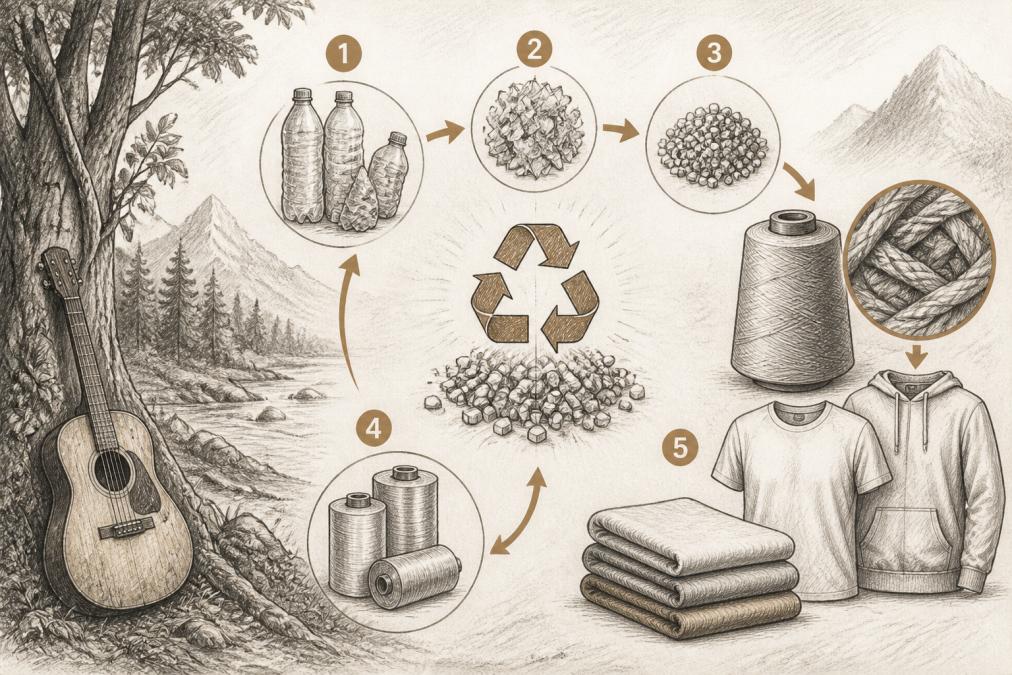
The journey runs roughly like this: bottles are collected through curbside programs and deposit schemes, sorted by color and resin type, stripped of caps and labels, washed, then shredded into flakes. Those flakes are melted and re-polymerized, and the resulting resin is extruded into filament and spun into yarn. The bottle becomes fiber. The fiber becomes fabric.
What most guides miss is that not all post-consumer feedstock is bottles. Fishing nets, carpet, and industrial strapping also enter the stream, and each brings different contamination challenges that affect the final polymer quality.
How rPET Is Manufactured: Mechanical and Chemical Recycling
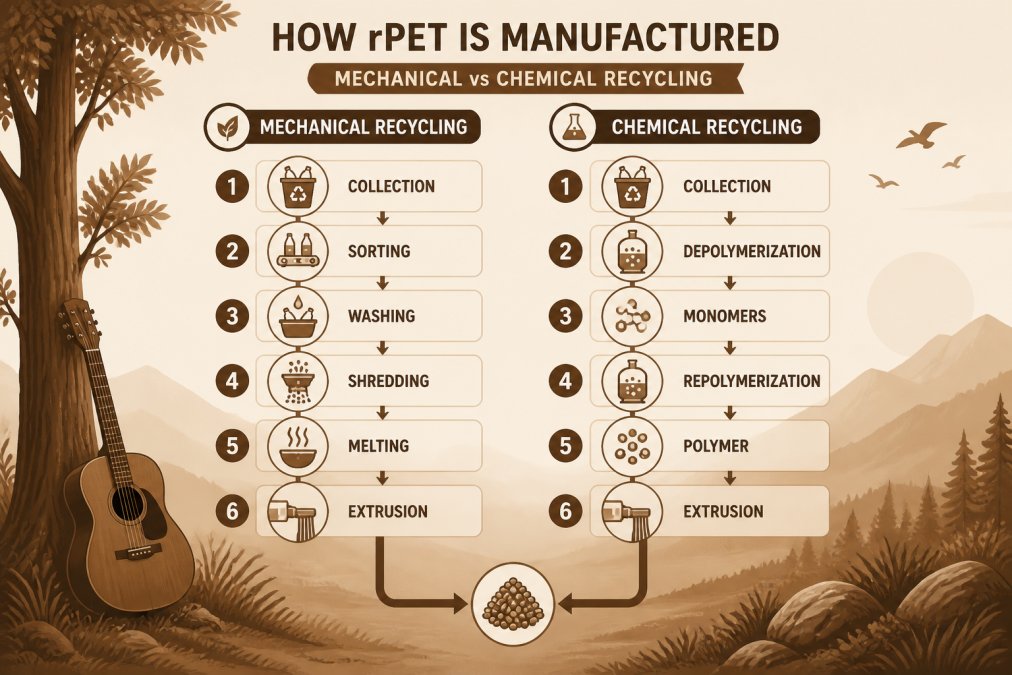
rPET is produced through one of two routes, and the route determines the quality of the fiber you eventually wear. Mechanical recycling dominates the market because it is cheaper and simpler. Chemical recycling is newer, costlier, and capable of handling waste streams that mechanical methods cannot.
Mechanical Recycling: Grind, Wash, Re-Melt
Mechanical recycling is a physical process. Collected PET is sorted by resin type and color, stripped of caps, labels, and adhesives, washed to remove food residue and dirt, then shredded into flakes. Those flakes are dried, melted, and extruded into pellets or directly into filament yarn.
The catch is thermal history. Every time PET is melted, the polymer chains shorten through a process called chain scission. Shorter chains mean lower intrinsic viscosity, which translates to weaker fiber. That is why mechanically recycled rPET is often blended with virgin polyester or chain extenders to hit performance targets for apparel. The more times a batch has been recycled, the more likely it needs virgin material to compensate.
Mechanical recycling also struggles with contamination. Colored bottles, multilayer packaging, and blended textiles introduce dyes, additives, and mixed polymers that degrade the output. That is why most mechanical rPET today comes from clear, single-color beverage bottles, the cleanest feedstock available.
Chemical Recycling: Back to Monomers
Chemical recycling takes a different approach. Instead of melting the polymer, it breaks the PET down to its original building blocks, the monomers ethylene glycol and terephthalic acid, or to intermediate compounds like BHET. Those monomers are then re-polymerized into PET that is chemically indistinguishable from virgin resin.
The two main chemical routes are glycolysis, which uses glycol to break the polymer into BHET, and methanolysis, which uses methanol to produce dimethyl terephthalate. Both can handle colored, contaminated, and blended feedstock that mechanical recycling cannot. The output is closer to virgin-grade, which matters for high-stress applications like workwear and technical textiles.
The trade-off is energy and cost. Chemical recycling is more energy-intensive than mechanical recycling, and the facilities are capital-heavy and still scaling up. Whether a given chemical recycling plant delivers a net emissions benefit depends heavily on the grid powering it and the feedstock it accepts.
Why Textile-to-Textile Is Harder Than Bottle-to-Textile
Here is the technical reason most recycled polyester is bottle-to-textile rather than textile-to-textile. Beverage bottles are made of a single polymer, PET, with predictable additives. Apparel is not. A typical garment blends polyester with cotton, spandex, or nylon, and includes zippers, buttons, elastic, and printed graphics. Separating those materials at scale is difficult and expensive.
Bottles also have a well-established collection infrastructure through curbside programs and deposit schemes. Post-consumer textiles do not. Most municipalities do not collect worn clothing for fiber recycling, and the sorting technology to identify fiber composition at speed is still maturing. That infrastructure gap, more than any chemistry problem, is what keeps textile-to-textile recycling from scaling.
Recycled Polyester vs Virgin Polyester: Key Differences
Recycled polyester and virgin polyester are chemically identical at the molecular level. The difference is the feedstock and the processing path, not the polymer itself. In practice, that means the two perform similarly on most measures, with a few honest exceptions.
| Factor | Recycled Polyester | Virgin Polyester |
|---|---|---|
| Feedstock | Post-consumer bottles, nets, textile waste | Petroleum-derived |
| Polymer quality | Good, sometimes blended | Consistent, uniform |
| Melting point | Comparable | Comparable |
| Dyeability | Comparable | Comparable |
| Cost | Usually higher | Lower |
| Waste diverted | Yes | No |
The catch is consistency. Virgin polyester is a uniform product from a controlled refinery process. Recycled polyester depends on what went into the bin, and contamination varies batch to batch. That variability is why some recycled fabrics feel slightly different from one order to the next.
For durable eco-friendly t-shirts, this matters less than people assume.
The Environmental Impact: Carbon Footprint, Energy, and Waste Diversion
The environmental case for recycled post-consumer polyester rests on three claims: lower carbon footprint, reduced energy consumption, and waste diversion. Each deserves scrutiny rather than blind acceptance.
Waste Diversion: The Clearest Win
Waste diversion is the most defensible benefit. Every kilogram of rPET fiber keeps plastic out of landfills and, in the case of fishing net recovery, out of the ocean. A single plastic beverage bottle yields roughly enough fiber for a portion of a t-shirt, so the material math is tangible. Fishing net recovery programs, in particular, address a waste stream that would otherwise persist in marine environments for centuries.
Energy and Emissions: Where the Numbers Get Murky
Energy and emissions are murkier than marketing suggests. Mechanical recycling generally uses less energy than producing virgin polyester from petroleum, which is why most lifecycle comparisons favor it. The commonly cited figure is that mechanically recycled PET can cut energy use substantially compared to virgin PET production, though the exact percentage varies widely by study, feedstock quality, and system boundaries.
The Open-Loop Problem and Downcycling
Here is the uncomfortable truth most marketing copy skips. Most recycled polyester today is downcycled, not truly circular. A bottle becomes a shirt, and that shirt is rarely recycled back into another shirt. It typically ends up landfilled or incinerated.
Microplastic Shedding: How Recycled Polyester Compares
Recycled polyester sheds microplastics during washing, and current evidence suggests it sheds at roughly similar rates to virgin polyester. The fiber chemistry is the same, so the shedding behavior is largely the same.
Durable Eco-Friendly T-Shirts: What to Look For
Durability is where recycled polyester earns its keep, if the garment is built well. Fiber origin matters less than fabric weight, stitch density, and blend ratio.
- Fabric weight: heavier knits resist pilling and hold shape through more wash cycles
- Blend ratio: recycled polyester blended with organic cotton often balances softness and strength better than either fiber alone
- Stitch density: tight, consistent stitching signals a garment built to last
- Care instructions: lower wash temperatures extend any synthetic fabric's lifespan
Traceability and Certification: How to Spot Greenwashing
For shoppers weighing recycled claims, the same rule applies everywhere: look for the certification, not the slogan.
Frequently Asked Questions
What is the difference between pre-consumer and post-consumer recycled polyester?
Post-consumer recycled polyester comes from plastic items that were used and discarded by consumers, like single-use bottles. Pre-consumer waste is scrap generated during manufacturing, such as factory offcuts that never reached a store shelf. Post-consumer material keeps plastic out of landfills and oceans, while pre-consumer recycling is more of an industrial efficiency measure. Both reduce the need for virgin petroleum-based raw materials, but post-consumer recycling delivers a bigger environmental impact because it addresses waste already in circulation.
Does recycled polyester shed microplastics?
Yes, all synthetic fibers including recycled post-consumer polyester shed microplastics during washing. Research shows the shedding rate depends more on fabric construction and yarn type than on whether the polyester is virgin or recycled. However, because rPET diverts plastic waste and reduces new plastic production, it still lowers the overall volume of plastic entering the environment. Using a microfiber-catching wash bag and washing less frequently can reduce shedding significantly.
What are the downsides of using recycled polyester?
The main downsides include the open-loop recycling problem (most rPET is downcycled and cannot be recycled indefinitely), potential quality variations depending on the source material, and the fact that rPET still sheds microplastics. Mechanical recycling can shorten polymer chains, which may reduce fiber strength over multiple cycles. Chemical recycling addresses this but is not yet widely available at scale. Energy consumption for collection and processing also adds to the carbon footprint, though it remains lower than producing virgin polyester from petroleum.
Is recycled polyester as durable as virgin polyester?
In most apparel applications, recycled post-consumer polyester matches virgin polyester in durability. Fiber strength depends on the polymerization and extrusion process, and modern rPET production can achieve comparable tensile strength. The key variable is the quality of the recycling stream; higher-grade sorted bottles produce stronger rPET. For durable eco-friendly t-shirts, look for brands that specify fiber quality and offer care instructions, since proper washing extends the life of any synthetic fabric.