 ultimate-guide
Why Ethical Clothing Costs More: The Real Breakdown
Table of Contents
- The True Cost of Fast Fashion: What You're Not Paying For
- Fair Wages and Safe Conditions: The Human Cost Behind Ethical Clothing
- Organic and Recycled Materials: Why They Cost More to Produce
- Small-Batch Production vs. Mass Production: Economies of Scale Explained
- How to Identify Ethical Fashion Brands (Without Falling for Greenwashing)
- How to Build a Sustainable Wardrobe on a Budget
- Conclusion: Making Ethical Clothing Affordable and Accessible
- Frequently Asked Questions
Last Updated: September 22, 2026
The True Cost of Fast Fashion: What You're Not Paying For
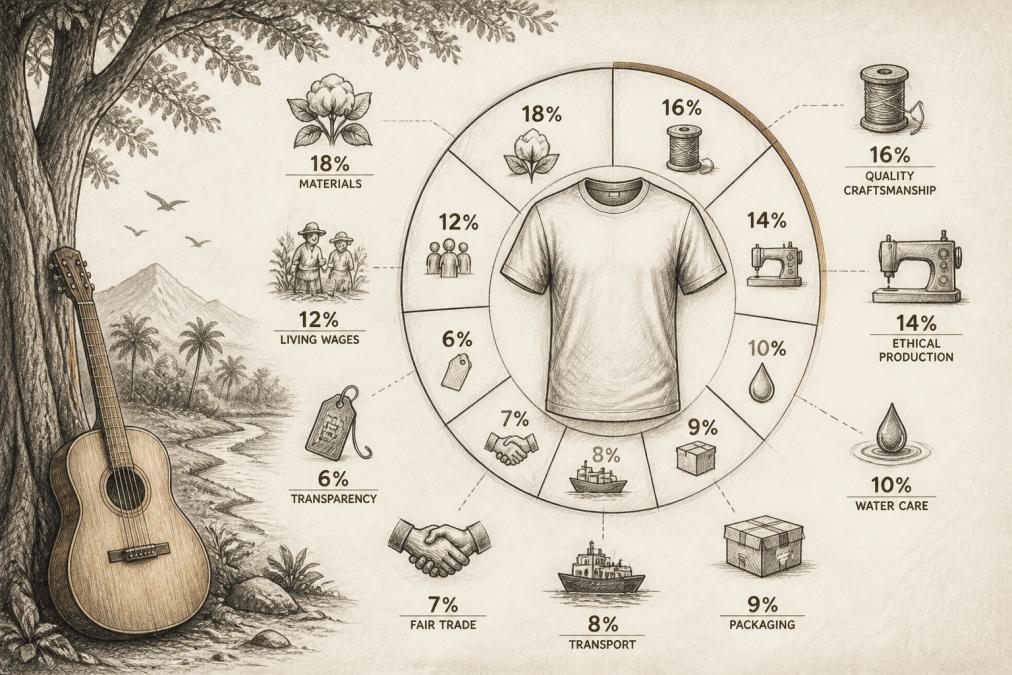
The reason ethical clothing costs more comes down to one uncomfortable fact: fast fashion prices are artificially low because someone else absorbs the difference. That difference shows up as underpaid labor, environmental damage, and garments designed to fall apart after a few washes. This guide from RastaHippies.com breaks down where the money actually goes at every stage of production, so the next price tag makes sense instead of just feeling like a penalty.
Ethical clothing is apparel produced with verified fair labor practices, environmentally responsible materials, and transparent supply chains, where the retail price reflects the true cost of making the garment. It is not a marketing label. It is a set of production decisions that carry real costs most fast fashion brands avoid by cutting corners upstream.
The math is not complicated once the layers are separated. A conventionally produced t-shirt can sell for less than a fast-food lunch because the cotton was grown with heavy pesticide use, the garment worker was paid a fraction of a living wage, and the fabric was engineered for a single season of wear. When those costs are restored to the equation, the price rises. That rise is not a markup. It is the bill finally being paid by the person wearing the shirt instead of by the people who made it.
Below, the breakdown covers wages, materials, production scale, and how to spot real ethical sourcing versus greenwashing, plus a cost-per-wear framework that often flips the "ethical is expensive" assumption on its head.
Fair Wages and Safe Conditions: The Human Cost Behind Ethical Clothing
Fair wages are the single largest line item separating ethical production from fast fashion, and the reason is straightforward: a living wage is calculated to cover housing, food, healthcare, and modest savings in the region where the garment is made, not just survival. Fast fashion supply chains frequently pay piece-rate wages that fall well below that threshold, and the savings get passed to the customer as a lower sticker price.
The difference compounds across a supply chain. A garment passes through cotton farming, spinning, dyeing, cutting, sewing, finishing, and shipping. Each stage has workers, and each stage has a wage floor. Ethical brands audit those floors and pay above them, which adds cost at every handoff. Fast fashion brands typically audit only the final assembly stage, if they audit at all, leaving the earlier links unverified.
Safe conditions carry their own cost. Proper ventilation in dye houses, fire exits, building inspections, and limits on overtime all require investment that a low-price model cannot absorb. When a brand commits to those standards, the per-unit cost rises, and that rise is the price of not cutting the corner.
Organic and Recycled Materials: Why They Cost More to Produce
Organic cotton and recycled fibers cost more because their production avoids the cheap shortcuts that conventional materials rely on, and because the certification that proves the difference is itself a line item. Organic cotton is grown without synthetic pesticides or fertilizers, which lowers yields per acre and requires more labor for weed and pest management. Recycled fibers require collection, sorting, and processing infrastructure that is still scaling up, so the per-kilogram cost stays higher than virgin synthetic fabric.
Synthetic fabrics like polyester are cheap because they are made from petroleum byproducts at industrial scale. The price does not reflect the microplastic shedding, the fossil fuel input, or the fact that the garment will persist in a landfill for centuries. Organic and recycled materials carry a higher upfront cost precisely because they do not offload those costs onto the environment.
Certification is a cost most shoppers never see. A mill that wants to sell cotton as GOTS-certified organic pays for annual inspections, chain-of-custody documentation, and testing at multiple stages, from the gin to the finished fabric. Those costs are real and they get passed down the supply chain. A brand that skips certification can call a fabric "natural" or "eco" for free, which is one reason vague language is so common and verified claims are not.
The fiber premium compounds at every stage. Organic cotton typically costs more per pound at the farm gate than conventional cotton, and the premium does not disappear when the fiber is spun, knit, dyed, or finished.
Small-Batch Production vs. Mass Production: Economies of Scale Explained
Economies of scale are the mechanical reason small-batch ethical production costs more per unit. When a factory runs 10,000 identical garments, the fixed costs of setup, pattern grading, and machine calibration are spread across all of them. When a brand runs 100, those same fixed costs land on far fewer units, and the per-item price climbs.
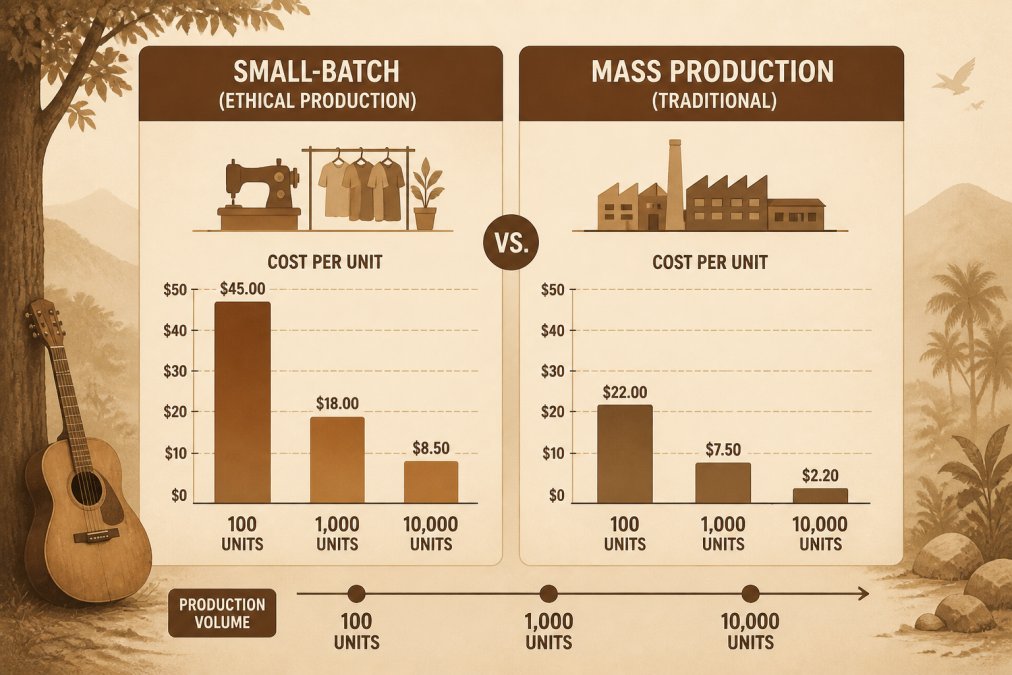
| Production Scale | Cost Per Unit | Quality Control | Inventory Waste | Best For |
|---|---|---|---|---|
| 100 units | Highest | Tightest | Lowest | Limited designs, specialty fabrics |
| 1,000 units | Moderate | Strong | Moderate | Core collections |
| 10,000 units | Lowest | Loosest | Highest | Mass-market basics |
How to Identify Ethical Fashion Brands (Without Falling for Greenwashing)
Identifying ethical fashion brands requires checking claims against evidence, not accepting a label at face value. Greenwashing works because vague language ("eco-friendly," "conscious," "natural") carries no verifiable meaning. A brand making a real commitment can point to specific certifications, published supplier lists, and third-party audits.
- Does the brand publish a full supplier list, not just a certification badge?
- Are certifications named specifically (GOTS for organic textiles, Fair Trade Certified, B Corp) rather than described in vague terms?
- Does the brand explain where its materials come from, down to the farm or recycling facility?
- Is there a public sustainability report with measurable targets, not just aspirational language?
- Does the brand disclose its wage policy and how it verifies living wages?
How to Build a Sustainable Wardrobe on a Budget
Building a sustainable wardrobe on a budget is possible because the goal is fewer, longer-lasting pieces, not a full replacement of everything already owned. The strategy is to buy less, choose pieces that survive many wears, and use cost-per-wear as the deciding metric rather than the sticker price.
The practical playbook:
- Start with what you own. Repair, rewear, and restyle before buying anything new.
- Buy second-hand first. Thrift stores, consignment shops, and resale platforms extend a garment's life without new production.
- Prioritize versatile pieces. A well-made jacket or pair of jeans worn weekly beats a trend item worn twice.
- Check cost-per-wear before every purchase. Divide the price by realistic wears, not optimistic ones.
- Wait for end-of-season sales on ethical brands. Many hold inventory and discount responsibly rather than overproducing.
Conclusion: Making Ethical Clothing Affordable and Accessible
The gap between fast fashion prices and ethical prices is real, and it exists because fast fashion externalizes costs that ethical production pays upfront. Understanding the breakdown, from living wages to organic materials to small-batch economies of scale, turns that gap from a barrier into a decision. Cost-per-wear, second-hand shopping, and buying fewer versatile pieces all make ethical clothing reachable on a real budget.
Frequently Asked Questions
Why is ethical clothing significantly more expensive than fast fashion?
Ethical clothing costs more because it reflects the true cost of production: fair wages for garment workers, safer working conditions, organic or recycled materials, and smaller production runs that lack economies of scale. Fast fashion keeps prices low by cutting corners on labor, using synthetic fabrics, and producing massive volumes that drive down per-unit costs. When you buy ethical clothing, you're paying for a supply chain that values people and the planet over maximum profit.
How can I build a sustainable wardrobe on a budget?
Start by shopping second-hand or thrifting, which gives you quality pieces at lower prices while keeping clothes out of landfills. Focus on cost-per-wear rather than upfront price: a well-made organic cotton tee that lasts five years costs less per wear than a cheap one that falls apart in months. Look for ethical brands that offer sales or basics lines, and prioritize versatile pieces you'll wear often. Repair and care for your clothes to extend their life, and consider clothing swaps with friends.
How do I know if a brand is truly ethical or just greenwashing?
Look for third-party certifications like Fair Trade Certified, GOTS (Global Organic Textile Standard), or B Corp, which require independent audits. Check the brand's website for specific details about their supply chain, factory names, and wage policies. Vague terms like 'eco-friendly' or 'sustainable' without proof are red flags. Transparent brands publish impact reports, name their suppliers, and openly discuss challenges. If a brand can't answer basic questions about where and how their clothes are made, be skeptical.
What is the 3-3-3 rule for clothes?
The 3-3-3 rule is a simple guideline for building a versatile wardrobe: choose 3 tops, 3 bottoms, and 3 pairs of shoes that can mix and match to create at least 9 different outfits. This approach encourages you to buy fewer, higher-quality pieces that work together, reducing impulse purchases and extending the life of your clothing. It's a practical way to embrace conscious consumerism and make the most of what you already own.