 listicle
Buy OEKO-TEX Certified Hoodies Online: 5 Best Picks for 2026
Table of Contents
- Quick Comparison: Top OEKO-TEX Certified Hoodies
- 1. Urban Native Era: Dual-Certified Streetwear
- 2. Pact: Affordable Organic Cotton Basics
- 3. Kotn: Premium Egyptian Cotton Hoodies
- 4. Everlane: Transparent Pricing and Modern Fits
- 5. Choosamazing on Etsy: Unique Small-Batch Hoodies
- Benefits of OEKO-TEX Certified Clothing for Sensitive Skin
- GOTS vs OEKO-TEX Certified Apparel: Key Differences
- How to Identify Certified Textile Labels
- Frequently Asked Questions
Last Updated: September 16, 2026
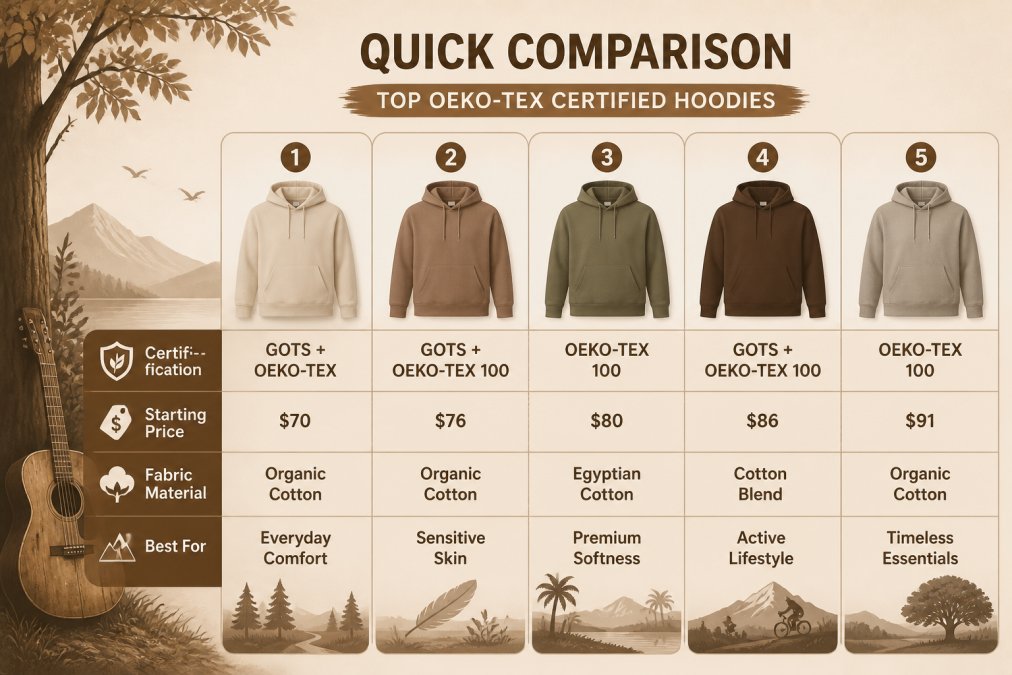
Quick Comparison: Top OEKO-TEX Certified Hoodies
Shoppers searching for oeko-tex certified hoodies are looking for one thing: proof that what touches their skin has been tested for harmful substances. OEKO-TEX Standard 100 is a third-party textile certification that screens every component of a garment, fabric, thread, zipper, drawcord, and print, against a published list of restricted chemicals. But certification alone does not tell you whether a hoodie will fit, whether it will keep you warm in January, or whether the seller is legitimate.
| Brand | Certification | Fabric | Starting Price | Best For |
|---|---|---|---|---|
| Urban Native Era | GOTS + OEKO-TEX | Organic cotton | $91 | Dual-certified streetwear |
| Pact | GOTS + OEKO-TEX 100 | Organic cotton | $70 | Affordable everyday basics |
| Kotn | OEKO-TEX | Egyptian cotton | $85 | Premium fabric quality |
| Everlane | OEKO-TEX | Cotton blends | $78 | Transparent sourcing |
| Choosamazing (Etsy) | OEKO-TEX | Cotton blend | $76.99 | Small-batch, unique colors |
Fabric Weight: The Spec Nobody Lists
Most certified hoodie listings bury the one number that determines whether you will actually wear the garment: fabric weight, measured in grams per square meter (GSM). A common pattern in the category:
- Under 250 GSM, lightweight, best for layering in spring and fall, often labeled "summer weight" or "lightweight fleece"
- 250-350 GSM, midweight, the everyday sweet spot for three-season wear
- 350-450 GSM, heavyweight, built for winter and outdoor use; expect a stiffer hand at first that softens after a few washes
- Over 450 GSM, very heavy, rare in certified cotton because the fabric cost climbs fast
Sizing for Sustainable Brands
Sustainable and small-batch brands often run on their own size charts, and a "Large" from one certified label can fit like a "Medium" from another. Before ordering online:
- Measure a hoodie you already own that fits the way you want, chest width (pit to pit), body length (shoulder seam to hem), and sleeve length.
- Compare those numbers to the brand's flat measurements, not the size letter. Flat measurements are the only reliable cross-brand comparison.
- Check the return window. Small-batch sellers on marketplaces like Etsy frequently run shorter return windows than established brands.
- Account for shrinkage. Unwashed organic cotton can shrink 3-5% on the first hot wash; washing cold and line drying minimizes it.
How to Read the Certification Column
A "GOTS + OEKO-TEX" listing means the garment meets both organic fiber standards and finished-product chemical safety testing. An "OEKO-TEX only" listing means the fabric and components were tested for harmful substances but the cotton may be conventional. Neither is a red flag, they answer different questions. The key is knowing which one you actually care about before you add to cart.
1. Urban Native Era: Dual-Certified Streetwear
Urban Native Era carries both GOTS and OEKO-TEX certification, a combination that covers organic farming standards and chemical safety in one garment. Hoodies start around $91, which puts the brand at the top of this price range. The tradeoff is real: shoppers pay more, but they get supply chain transparency that few streetwear labels match. Where it falls short is color range and restock speed, so popular sizes sell out fast.
2. Pact: Affordable Organic Cotton Basics
Pact keeps prices lower than most certified competitors, with hoodies starting near $70. The brand uses GOTS certified organic cotton and OEKO-TEX Standard 100 certified fabrics, plus Fair Trade Certified factory partnerships. A common mistake shoppers make is waiting too long to buy: Pact's inventory fluctuates with seasonal collections, and staple colors disappear between drops. For everyday wear at a fair price, this is the strongest value on the list.
3. Kotn: Premium Egyptian Cotton Hoodies
Kotn builds hoodies from direct-trade Egyptian cotton and certifies its non-toxic dyes through OEKO-TEX. Starting around $85, the fabric quality justifies the price for shoppers who care about how a garment feels after fifty washes. The limitation is choice: Kotn runs a minimalist palette, so anyone wanting loud colors or graphic prints will need to look elsewhere.
4. Everlane: Transparent Pricing and Modern Fits
Everlane publishes factory-level detail for most products and applies OEKO-TEX certified textile processing across its line. Hoodies start near $78, and sizing runs consistent across seasons, which matters for online ordering. One caveat: not every Everlane item is organic, so check each label individually rather than assuming the whole catalog qualifies.
5. Choosamazing on Etsy: Unique Small-Batch Hoodies
Choosamazing sells through Etsy at roughly $76.99, offering OEKO-TEX certified fabric in vibrant colorways that mass producers skip. Small-batch production means limited runs and shipping times that vary by seller. For shoppers who want certified fabric without wearing the same hoodie as everyone else, this is the pick.
Benefits of OEKO-TEX Certified Clothing for Sensitive Skin
OEKO-TEX certified clothing matters most for people with skin sensitivity because the certification tests for harmful substances at levels far stricter than general consumer safety rules require. Independent testing covers pesticides, heavy metals, formaldehyde, and azo dyes, the residues most likely to trigger irritation in chemically treated fabrics.
The practical benefits stack up quickly:
- Hypoallergenic finishes reduce contact irritation for reactive skin
- Pesticide-free cotton limits residue exposure during wear
- Tested dyeing processes cut the risk of dye-related reactions
- Third-party verified claims replace vague "natural" marketing language
GOTS vs OEKO-TEX Certified Apparel: Key Differences
GOTS and OEKO-TEX answer different questions. GOTS certifies the entire organic supply chain, from farm to finished garment, including labor and environmental standards. OEKO-TEX Standard 100 tests the finished product for harmful substances, regardless of whether the fiber is organic. A hoodie can hold OEKO-TEX certification without containing any organic cotton at all.
| Standard | What It Covers | Scope | Best Signal For |
|---|---|---|---|
| GOTS | Organic fiber, processing, labor | Farm to finished product | Organic sourcing |
| OEKO-TEX Standard 100 | Chemical safety testing | Finished product and components | Skin safety |
How to Identify Certified Textile Labels
Most guides tell you to "look for the label." That is not enough. Counterfeit and misleading certification tags exist, and the difference between a real OEKO-TEX Standard 100 label and a printed logo is usually one detail: the traceable certification number. Here is how to tell them apart before you buy.
Real vs. Fake: A Visual Checklist
A legitimate OEKO-TEX Standard 100 label includes all of the following:
-
The words "OEKO-TEX Standard 100" spelled out, not "Oeko Tex," "OekoTex Certified," or a generic leaf icon
-
A certificate number in the format
XX-XXXXX(two letters, a hyphen, five digits), sometimes followed by a testing institute code -
The issuing institute name (for example, a Hohenstein or Shirley Technologies reference)
-
The year the certificate was issued
-
A logo with no number at all
-
A number that does not match the
XX-XXXXXformat -
Vague phrases like "eco-certified," "green tested," or "non-toxic" with no standard named
-
A number that returns no match in the official database
Step-by-Step Verification
- Find the number. Check the neck label, the hang tag, or the product listing photos. If the seller does not show the label, ask for a photo before ordering.
- Enter it in the official database. The OEKO-TEX label check tool returns the certificate holder, product category, and validity dates.
- Match the certificate holder to the seller. If the database returns a manufacturer name that does not match the brand you are buying from, the fabric may be certified but the finished garment may not be.
- Check the validity dates. Certificates expire and are renewed annually. An expired number means the current production run is not covered.
- Confirm the product category. OEKO-TEX Standard 100 has four product classes (I for baby items, II for items worn next to skin, III for outerwear, IV for furnishings). A hoodie should fall under Class II or III, if the certificate lists Class IV only, it was not tested for skin contact.
What the Law Says About Certification Claims
The Federal Trade Commission's Green Guides set the rules for environmental marketing claims, and brands that make unqualified "sustainable" or "non-toxic" claims without proof risk enforcement. The Consumer Product Safety Commission also publishes guidance on textile flammability and chemical limits that apply to apparel sold in the country. When a label cannot be verified against the OEKO-TEX database, treat the claim as unproven, no matter how convincing the marketing copy is.
Frequently Asked Questions
What does OEKO-TEX Standard 100 certification mean for hoodies?
OEKO-TEX Standard 100 means every component of the hoodie, including fabric, thread, zippers, and labels, has been tested for harmful substances like heavy metals, formaldehyde, and pesticide residues. Products are tested against over 100 parameters, many stricter than federal requirements. For hoodies, this matters because dyes and finishes sit against your skin for hours. Look for the certificate number on the label to verify.
How can I verify if a hoodie is truly OEKO-TEX certified?
Check the label for a certificate number, then enter it on the OEKO-TEX website's label check tool. Legitimate brands display this number on product pages or hangtags. If a brand claims certification but provides no verifiable number, treat it as unconfirmed. You can also email the brand asking for their certificate scope and issuing institute, which serious companies share readily.
Is there a difference between OEKO-TEX and GOTS certification?
GOTS covers the entire organic textile supply chain, from farming to finished product, requiring at least 70% organic fibers and strict environmental and labor standards. OEKO-TEX Standard 100 focuses specifically on chemical safety testing of the final product. A hoodie can be OEKO-TEX certified without being organic, and GOTS-certified products automatically meet OEKO-TEX chemical requirements.
Are OEKO-TEX certified hoodies better for sensitive skin?
Yes, they reduce exposure to common irritants found in conventional dyes, formaldehyde finishes, and heavy metal residues. People with eczema, contact dermatitis, or chemical sensitivities often notice fewer reactions. The certification tests for substances that trigger skin sensitivity, making these hoodies a practical choice when regular apparel causes itching or rashes.
Where can I buy affordable OEKO-TEX certified hoodies online?
Pact offers certified organic cotton hoodies starting around $70, making them accessible for everyday wear. Kotn and Everlane sit in the $78-$85 range with strong transparency. For unique options, Etsy sellers like Choosamazing provide small-batch certified hoodies. Always verify the certificate number on the brand's site before purchasing to confirm current certification status.