 ultimate-guide
Buy OEKO-TEX Certified Casual Apparel: Your 2026 Guide
Table of Contents
- What OEKO-TEX Standard 100 Certification Actually Means
- Why It Matters: Key Benefits of OEKO-TEX Certified Clothing
- OEKO-TEX vs. GOTS: Which Certification Should You Trust?
- How to Identify OEKO-TEX Labels and Verify Authenticity
- What to Look for When You Buy OEKO-TEX Certified Casual Apparel
- Common Myths and Greenwashing Traps to Avoid
- Find Your Fit: Building a Safer, Cleaner Wardrobe
- Frequently Asked Questions
Last Updated: September 6, 2026
When you buy OEKO-TEX certified casual apparel, you are choosing pieces that have passed independent laboratory testing for more than 1,000 harmful substances. OEKO-TEX certified clothing is textile tested at every stage of production, from raw fibers to finished garments, ensuring chemical residues stay far below strict safety limits. This guide breaks down what the certification actually covers, how to spot authentic labels, and why these standards matter for your everyday wardrobe.
The casual apparel market is flooded with vague eco-claims, making it hard to separate genuine textile safety from marketing noise. Many shoppers assume organic cotton and certified cotton are the same thing. They are not. The OEKO-TEX Standard 100 certification focuses specifically on consumer health, testing for harmful substances rather than farming methods. Below, we will show you exactly how to verify labels, decode product classes, and avoid greenwashing traps when you shop.
What OEKO-TEX Standard 100 Certification Actually Means
OEKO-TEX Standard 100 is a globally recognized textile certification system that tests finished products at every stage of production for harmful substances (oeko-tex.com). The testing covers regulated and non-regulated substances, including pesticides, heavy metals, formaldehyde, and allergenic dyes. Textile testing happens through 18 independent institutes worldwide, giving the label real weight beyond self-declared sustainability claims.
The certification assigns each product a product class based on its intended skin contact. Class 1 covers baby items, Class 2 covers items worn close to the skin, Class 3 covers outerwear, and Class 4 covers furnishing materials. When you buy OEKO-TEX certified casual apparel, you want to see Class 1 or Class 2, since those categories face the strictest limits for chemical residues.
Why It Matters: Key Benefits of OEKO-TEX Certified Clothing
The most immediate benefit of OEKO-TEX certified clothing is consumer health, but the specific value proposition goes far beyond a general sense of 'being safe.' For a significant portion of the population, the certification is a direct answer to a chronic, daily irritant: textile dermatitis. This condition is a form of contact dermatitis triggered by chemicals used in garment production, such as disperse dyes, formaldehyde-based resin finishes, and certain heavy metal mordants. The American Academy of Dermatology notes that allergic contact dermatitis is a common issue, and for many, the culprit is their clothing (the American Academy of Dermatology).
Standard 100 certification directly addresses this by setting strict limits on these specific allergens. For example, the standard restricts the use of allergenic disperse dyes, which are a common cause of textile-related skin reactions. It also caps the level of formaldehyde, a chemical used to prevent wrinkling, which can cause significant skin and respiratory irritation. By choosing certified apparel, you are not just buying a shirt; you are buying a garment that has been screened against a known list of dermatological irritants, offering a tangible, hypoallergenic benefit for those with sensitive skin, eczema, or psoriasis.
Beyond personal health, the certification drives supply chain transparency. Factories must be re-audited annually, and every component, from thread to buttons, must comply. This creates a quality assurance loop that fast fashion rarely matches. Garment durability improves because certified fabrics avoid harsh chemical treatments that weaken fibers over time. A common pattern is that certified garments, particularly those made from cotton, retain their structural integrity and color after repeated washing because they haven't been subjected to the aggressive finishing agents that break down fibers. This lifecycle advantage means a certified t-shirt is less likely to pill, fade, or lose its shape after a season of use, offering a better cost-per-wear value than a non-certified equivalent.
Furthermore, the health benefits extend to the people who make the clothes. While Standard 100 is a product test, the annual factory audits required for certification often include checks on workplace safety and social compliance, aligning with the broader principles of the OEKO-TEX association.
OEKO-TEX vs. GOTS: Which Certification Should You Trust?
The difference between GOTS and OEKO-TEX certification comes down to scope. GOTS, or the Global Organic Textile Standard, verifies organic farming practices and social criteria across the entire supply chain (global-standard.org). OEKO-TEX Standard 100 focuses strictly on testing the finished textile for harmful substances, regardless of whether the fiber is organic or conventional.
Neither certification is better across the board. GOTS vs OEKO-TEX certification is a question of priorities. If your main concern is avoiding chemical residues on your skin, OEKO-TEX gives you the strongest assurance. If you want to support organic farming and ethical labor from seed to shelf, GOTS covers more ground. Many premium brands hold both certifications, which offers the most complete protection.
| Certification | Primary Focus | Covers Farming | Testing Method | Best For |
|---|---|---|---|---|
| OEKO-TEX Standard 100 | Consumer health, harmful substances | No | Independent lab testing of finished goods | Skin safety and chemical residue control |
| GOTS | Organic fiber, social criteria | Yes | On-site audits and lab testing | Full supply chain transparency |
How to Identify OEKO-TEX Labels and Verify Authenticity
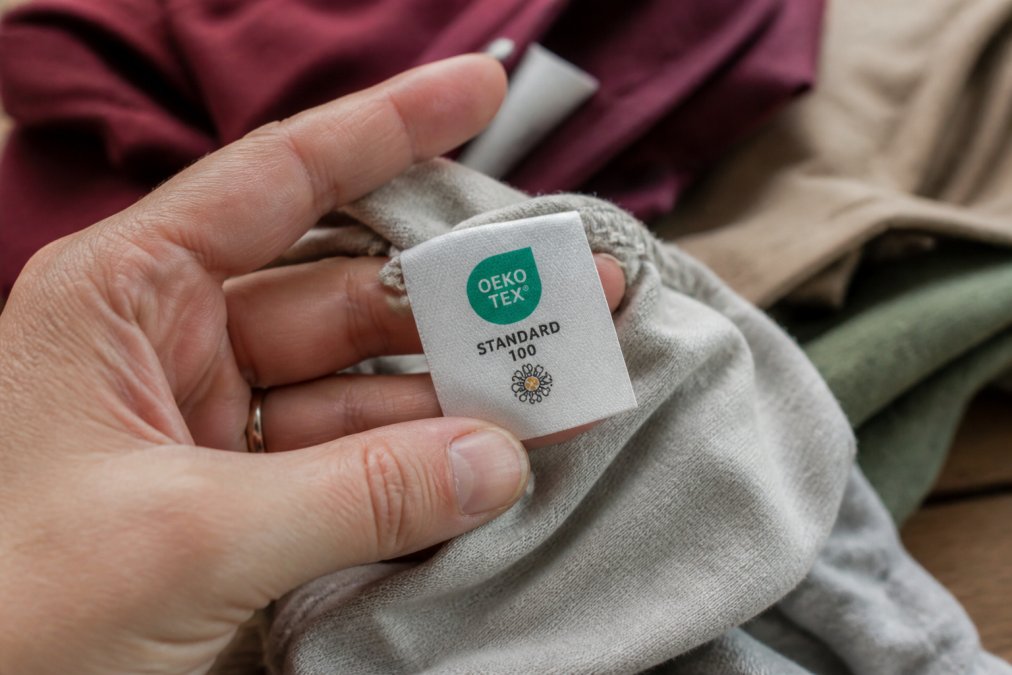
Authentic OEKO-TEX labels display the Standard 100 logo, the test institute number, and a scannable QR code or label number. Learning how to identify OEKO-TEX labels starts with checking for these three elements together. A genuine label always names the testing institute, such as Hohenstein or TESTEX, alongside the certification number.
You can verify any label using the OEKO-TEX official database, which lets you search by the label number to confirm the certificate is current and valid. This step takes under a minute and immediately exposes counterfeit claims. Be cautious of hang tags that show only the logo without the test institute details, since these are often printed by brands without going through the actual certification process.
What to Look for When You Buy OEKO-TEX Certified Casual Apparel
When you buy OEKO-TEX certified casual apparel, start by checking the care label for the sewn-in Standard 100 mark rather than relying on marketing photos. Look for the product class designation and confirm it matches the garment's intended use. Everyday essentials like t-shirts and underwear should be Class 1 or Class 2 to ensure the strictest limits apply.
Consider the fabric composition alongside the certification. Sustainable apparel brands often pair OEKO-TEX certified cotton with recycled fibers, which reduces environmental impact without sacrificing textile safety. Check the garment construction too, since certified fabrics still need quality stitching and finishing to last through repeated washing.
A practical shopping checklist helps you stay consistent:
- Confirm the sewn-in label shows the Standard 100 logo with a certificate number
- Verify the certificate in the OEKO-TEX database before purchasing
- Choose Class 1 or Class 2 for items worn directly against the skin
- Check fiber content and washing instructions to protect garment durability
- Look for brands that publish their certificate numbers openly on product pages
Common Myths and Greenwashing Traps to Avoid
The biggest greenwashing trap is confusing vague phrases like "eco-friendly manufacturing" with verified textile certification. Words like natural, green, and non-toxic have no legal definition and require no independent testing. OEKO-TEX certified is a verifiable claim backed by laboratory analysis, while these loose terms are simply marketing language.
Another common myth is that OEKO-TEX certification guarantees organic farming. It does not. A garment can be certified under Standard 100 while using conventionally grown cotton. If organic sourcing matters to you, look for a separate organic certification in addition to the OEKO-TEX label.
Many shoppers also assume certified means the entire brand is sustainable. The reality is that certification applies to specific products, not entire companies. A brand can sell one certified line alongside uncertified fast fashion pieces. Always check the individual item's label rather than trusting a brand-wide sustainability page.
Perhaps the most misunderstood aspect of the label is the Product Class system. Many shoppers see the Standard 100 logo and assume all certified products are held to the same standard. This is a critical error. The OEKO-TEX Standard 100 certification has four distinct product classes, each with its own set of testing criteria and permissible limits for harmful substances. The limits are not uniform; they are tiered based on the product's intended level of skin contact.
- Product Class I: This is the most stringent category, reserved for items intended for babies and toddlers up to 3 years of age. This includes items like bodysuits, soft toys, and bedding. The limits for chemicals are at their absolute lowest here.
- Product Class II: This covers items that are worn in direct and prolonged contact with the skin. This is the category that applies to most casual apparel you will buy, including t-shirts, underwear, socks, and hoodies. The limits are slightly less strict than Class I but still far more rigorous than non-certified textiles.
- Product Class III: This applies to outerwear that does not have direct, prolonged skin contact, such as jackets and coats. These items are typically worn over a Class II garment.
- Product Class IV: This is for furnishing materials like curtains, tablecloths, and upholstery fabrics, which have minimal to no direct skin contact.
When you are shopping for casual apparel, you should specifically look for the product class designation on the label. For a t-shirt or a pair of leggings that will sit against your skin all day, you want to see Product Class II (or Class I, which is even better). If you see Class III on a garment marketed as a base layer, that is a sign that the certification level does not match the intended use, and you should be cautious. Decoding this level of detail is the difference between a casual shopper and an informed consumer, ensuring you are getting the highest level of protection for the items that matter most.
Find Your Fit: Building a Safer, Cleaner Wardrobe
Building a safer wardrobe starts with identifying which pieces touch your skin most often and prioritizing certified versions of those items first. T-shirts, hoodies, and loungewear are the highest-impact swaps because they sit directly against your skin for hours. Once you replace those essentials, expand outward to outerwear and accessories.
At Rasta Hippies, we believe conscious consumption should celebrate your values, not restrict them. Our original art and handcrafted apparel are designed for high-frequency living, letting you express your individual truth while supporting charitable foundations dedicated to ocean and environmental conservation.
The shift toward safer textiles is part of a broader movement in ethical fashion. As more shoppers demand supply chain transparency, brands are responding with verifiable certifications rather than empty promises. By learning to decode labels and verify claims, you become part of that pressure for change.
Frequently Asked Questions
Is OEKO-TEX certification the same as organic cotton?
No. OEKO-TEX Standard 100 tests the finished product for harmful substances, while organic cotton refers to how the cotton is grown without synthetic pesticides. A garment can be OEKO-TEX certified without being organic. For the strictest environmental standards from seed to finished item, look for GOTS certification, which covers both organic farming and social criteria.
How can I verify if a clothing brand is truly OEKO-TEX certified?
Look for the official OEKO-TEX label with the Standard 100 logo and a unique label number. You can enter this number into the OEKO-TEX 'Label Check' tool on their official website to confirm the certificate is valid and see which product class was tested. Legitimate brands will also often list their certificate number on their website or product pages.
Does OEKO-TEX certification cover the entire manufacturing process?
OEKO-TEX Standard 100 focuses on testing the final product and its components for harmful substances. It does not audit the entire manufacturing process like GOTS does. However, OEKO-TEX also offers STeP certification, which independently audits factories for environmentally friendly production and social working conditions. For complete supply chain transparency, look for brands that hold both certifications.
Why should I choose OEKO-TEX certified apparel for my daily wardrobe?
Choosing OEKO-TEX certified apparel means opting for pieces tested for over 1,000 harmful substances. This is particularly valuable for everyday essentials worn close to the skin, as it reduces your exposure to chemical residues and is a safer option for sensitive skin. It also supports supply chain transparency and safer manufacturing practices.
Building a cleaner wardrobe means looking past marketing language and demanding proof of textile safety at every purchase. OEKO-TEX certified apparel offers that proof through independent testing, giving you peace of mind about what touches your skin. Rasta Hippies combines this commitment to conscious quality with original designs rooted in peace, freedom, and nature. Explore our certified collection and add pieces that align with your values today.