 ultimate-guide
Ethical Hippie Fashion Brand Guide: 2026
Table of Contents
- What Makes Ethical Hippie Fashion Different
- How to Evaluate Ethical Boho Clothing Brands
- Fair Trade Clothing Brands Worth Supporting
- Sustainable Boho Apparel: Materials That Matter
- Ethical Boho Clothing Brands for Every Budget
- Inclusive Sizing and Accessibility in Ethical Fashion
- Beyond the Purchase: Resale, Repair, and End-of-Life
- Frequently Asked Questions
Last Updated: October 19, 2026
What Makes Ethical Hippie Fashion Different
Ethical hippie fashion is a commitment to aligning personal values with what you wear. Unlike mainstream fashion that prioritizes trends and profit margins, ethical hippie fashion brands prioritize transparency, worker welfare, and environmental stewardship.
The core difference lies in intentionality. Ethical boho clothing brands ask hard questions about every step of production: Who made this? Were they paid fairly? What materials were used?
Brands committed to this approach often work directly with artisans, use organic or recycled fabrics, and maintain transparent relationships with manufacturers. This alignment between values and commerce distinguishes genuine ethical hippie fashion brand guides from greenwashing.
How to Evaluate Ethical Boho Clothing Brands
Evaluating whether a brand is genuinely ethical requires a repeatable framework rather than marketing claims alone. Start with supply chain transparency: can the brand tell you exactly where garments are made and by whom?
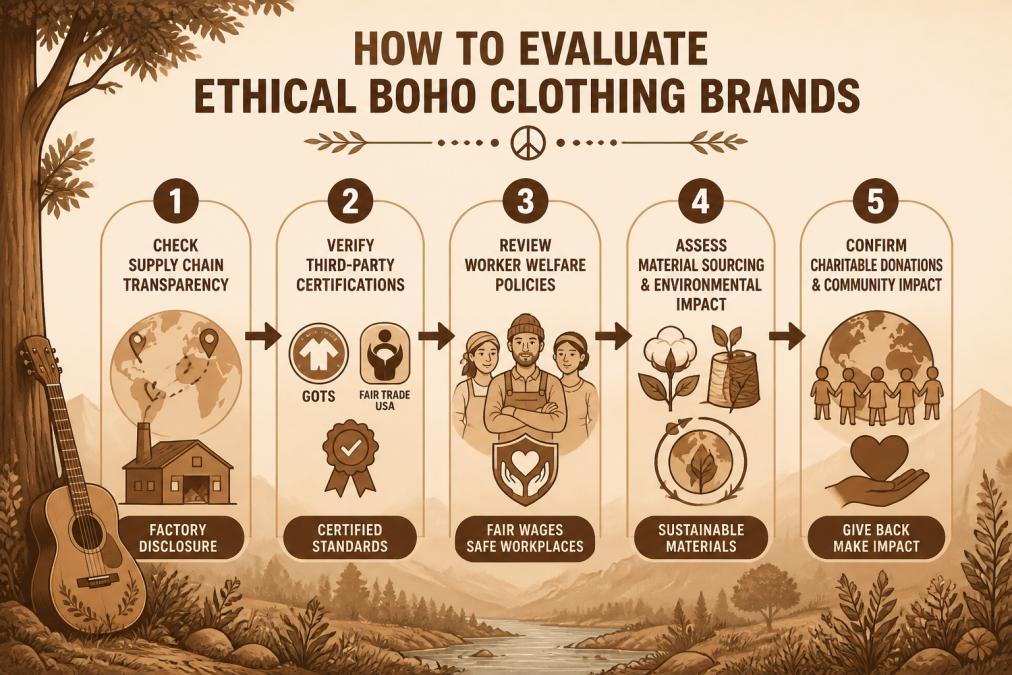
Next, verify certifications and sustainability claims. Look for third-party certifications like Fair Trade USA, Global Organic Textile Standard (GOTS), or B Corp certification, independent verification rather than self-applied labels.
Supply Chain Transparency and Worker Welfare
Transparency forms the foundation of ethical fashion. Real ethical hippie fashion brand guide creators examine whether companies disclose factory locations, worker conditions, and wage information.
Worker welfare encompasses fair wages, safe working conditions, reasonable hours, and freedom of association. Some ethical boho clothing brands go further, offering healthcare, education support, or profit-sharing. Request this information directly, legitimate companies welcome these questions.
Certification and Sustainability Claims
Certifications serve as third-party verification that brands meet specific standards. Fair Trade USA ensures workers earn living wages and work in safe conditions. GOTS certifies organic fiber production and responsible manufacturing.
Be cautious of unverified claims. Terms like "eco-friendly," "natural," or "sustainable" often carry no legal definition. Brands making these claims should provide supporting documentation. When evaluating ethical boho clothing brands, cross-reference claims against certification databases and ask for proof.
Fair Trade Clothing Brands Worth Supporting
Fair trade is a specific claim, not a vibe. In the United States, the label most shoppers encounter is Fair Trade Certified apparel, administered by Fair Trade USA. To carry it, a factory must meet social and environmental standards, and workers receive a Community Development Premium, an additional sum paid on top of wages that a worker-managed committee decides how to spend, often on healthcare, education, or safety equipment.
What Fair Trade Actually Requires
A credible fair trade program typically covers four areas:
- Wages and hours. Workers must earn at least the legal minimum and, in stronger programs, a living wage benchmark for the region. Overtime must be voluntary and compensated at a premium.
- Safe conditions. Factories must meet health and safety standards, with independent audits rather than self-reporting.
- Freedom of association. Workers can organize and bargain collectively without retaliation.
Genuinely fair trade brands often publish supplier factory names and locations plus audit summaries. If a brand says "fair trade" but won't name the factory or certifier, treat the claim as marketing until proven otherwise.
How to Verify a Fair Trade Claim
- Find the certification mark. Look for the Fair Trade Certified seal on the product page or hangtag, not just in a brand's About section.
- Check the certifier's database. Fair Trade USA and similar bodies maintain searchable lists of certified products and facilities. Cross-reference the brand there.
- Ask for the factory. Legitimate brands can name the facility and country of manufacture. Vague answers like "our partners overseas" are a warning sign.
- Look for the premium. Ask whether workers receive a Community Development Premium and how it has been used. Brands proud of this will tell you.
Trade-Offs to Expect
Fair trade apparel usually costs more: certified factories pay for audits, and the Community Development Premium adds to unit cost. Selection is narrower, certification is more common in basics, accessories, and small-batch artisan goods than trend-driven fashion. Certification also covers the sewing facility, not every fiber supplier upstream, so pair a fair trade check with a materials check.
Where Fair Trade Fits in a Hippie Wardrobe
The bohemian and hippie aesthetic has always leaned on artisan-made goods, block-printed textiles, hand-knit pieces, beaded accessories. Fair trade certification is one of the few credible ways to confirm the artisan was paid and worked under verified conditions. Prioritize brands that combine a fair trade mark with named artisan cooperatives and published production stories, third-party verification plus human attribution is the strongest signal available.
Fair Trade USA certified products database
Sustainable Boho Apparel: Materials That Matter
Material choice directly impacts the environmental and social footprint of clothing. Sustainable boho apparel prioritizes natural fibers, recycled fabrics, and responsible production methods. Understanding material options helps consumers make informed, values-aligned choices.
Natural Fibers and Recycled Fabrics
Organic cotton eliminates synthetic pesticides and fertilizers while supporting soil health. Hemp requires minimal water and no pesticides, making it one of the most sustainable natural fibers.
Recycled fabrics reduce waste by giving new life to existing materials. Recycled polyester, made from plastic bottles or worn garments, diverts waste from landfills. Recycled cotton uses post-consumer waste, reducing demand for virgin fiber.
Durability and the 30 Wear Rule Fashion Standard
The 30 wear rule suggests clothing should be worn at least 30 times to justify its environmental impact. Durable garments reduce frequent replacement, lowering overall consumption. Quality construction, natural fibers, and timeless design extend garment lifespan significantly.
Ethical hippie fashion brand recommendations should emphasize durability alongside sustainability. A sustainably made garment that falls apart after five wears creates more waste than a conventionally made piece worn for years.
Ethical Boho Clothing Brands for Every Budget
Ethical fashion doesn't require unlimited spending. Budget-conscious consumers can support ethical hippie fashion by prioritizing quality over quantity and shopping strategically.
Entry-level options focus on basics: tees, tanks, and foundational pieces in organic cotton or recycled materials.
Evaluate value beyond price. A higher-priced garment made from organic materials by fairly paid artisans offers better long-term value than cheaper fast fashion.
Inclusive Sizing and Accessibility in Ethical Fashion
Most ethical fashion guides quietly assume a straight-size, women-only, able-bodied shopper. That assumption is a gap worth naming, because a brand cannot be called ethical if its ethics stop at a size 12. Here's what genuine inclusivity looks like and how to check for it.
What "Inclusive Sizing" Should Mean
A common pattern among brands that market inclusivity is extending a size run to 2X or 3X while grading the pattern up from a straight-size block, which produces poor fit at the larger end. Genuine inclusive sizing usually involves:
- Separate pattern blocks for extended sizes rather than scaled-up versions of smaller patterns.
- Consistent availability. Extended sizes stocked year-round, not released as a limited capsule and then dropped.
- Fit models across the size range, not a single fit model at the small end.
When you evaluate a brand, check whether extended sizes appear in the main collection or in a separate, smaller "plus" section. The former signals commitment; the latter often signals an afterthought.
Accessibility Beyond Size
Accessibility covers how easily a person can find, evaluate, and receive a garment:
- Detailed product pages. Fabric weight, stretch, care instructions, and model measurements (including the model's height and size worn) reduce guesswork for online shoppers.
- Fit and measurement guides with real garment measurements, not generic body charts.
- Easy returns and exchanges, ideally with prepaid labels, so a first-time buyer can try a brand without financial risk.
Gender-Inclusive and Budget-Inclusive Options
The hippie and bohemian aesthetic has historically been fluid, loose silhouettes, layered textiles, and unisex accessories lend themselves to gender-inclusive design. Look for brands that label pieces as unisex or offer the same garment across men's and women's sections, and check whether size charts are provided per fit rather than assumed.
Budget inclusivity matters too. Ethical fashion has a reputation for being expensive, and some of that is unavoidable, fair wages and certified materials cost more.
How to Check a Brand's Inclusivity Claims
- Count the sizes. Does the size run go beyond XL, and is it consistent across products?
- Read the size chart. Are garment measurements published, or only body measurements?
- Check the return policy. Is it free or low-cost, and does it apply to extended sizes?
- Look at the photography. Are larger bodies represented by actual fit models or only in marketing campaigns?
- Ask directly. A brand that welcomes the question and answers with specifics is more credible than one that deflects.
Inclusivity is not a marketing checkbox. It is a set of operational choices, pattern grading, stock depth, photography, and returns, that determine whether an ethical brand actually serves the people who want to shop it.
Beyond the Purchase: Resale, Repair, and End-of-Life
True sustainability extends beyond the initial purchase. Ethical boho clothing brands increasingly support resale, repair, and responsible end-of-life options.
Many brands offer repair services, in-house or through partnerships, and some provide repair kits or instructions for common wear patterns.
Brands investing in resale, repair, and recycling infrastructure prove their dedication to genuine sustainability rather than temporary trends.
Finding ethical hippie fashion requires patience, research, and commitment to values-aligned shopping.
Frequently Asked Questions
What are the key differences between ethical hippie fashion brands and fast fashion?
Ethical hippie fashion brands prioritize supply chain transparency, fair wages for workers, and sustainable materials. They often support charitable causes and produce in smaller quantities with intentional design. Fast fashion prioritizes speed and volume, typically using synthetic materials and opaque labor practices. Ethical brands encourage the 30 wear rule, designing garments meant to be worn at least 30 times, while fast fashion promotes constant consumption and disposal.
How can I verify that a boho clothing brand's sustainability claims are legitimate?
Look for third-party certifications like Fair Trade Certified, GOTS (Global Organic Textile Standard), or B Corp status. Request the brand's supply chain information and worker welfare policies. Check if they publish annual impact reports or partner with verified charitable organizations. Legitimate brands are transparent about their manufacturing locations, material sourcing, and environmental practices. Be skeptical of vague claims like 'eco-friendly' without specific certifications or data backing them up.
What materials should I prioritize when shopping for sustainable boho apparel?
Organic cotton, hemp, linen, and TENCEL are excellent choices for sustainable boho apparel. These materials require fewer chemicals and water than conventional fabrics. Recycled fabrics reduce waste and textile impact. Look for brands that disclose their material sourcing and processing methods. Natural fibers tend to be more durable and breathable, aligning with the hippie values of comfort and connection to nature. Avoid synthetic blends unless the brand specifically explains their durability or performance benefits.
Why do ethical hippie fashion brands cost more than conventional retailers?
Higher prices reflect fair wages for workers, organic or recycled material sourcing, smaller production runs, and third-party certifications. Ethical brands invest in transparency, supply chain audits, and often donate portions of proceeds to charitable causes. These garments are designed for longevity and the 30 wear rule fashion standard, meaning you wear them more times before replacement. The lower environmental and human cost per wear actually makes ethical fashion more economical over time compared to disposable alternatives.
How do I know if a brand actually donates to charitable causes as they claim?
Request documentation showing which organizations they partner with and what percentage of profits go to charity. Legitimate brands publish annual reports or impact statements listing specific donations and verified partner organizations. Check the charity's website to confirm the partnership exists. Some brands may link to third-party platforms that track their charitable giving. If a brand cannot provide clear evidence of donations or partner names, treat their claims with skepticism.
What does the 30 wear rule fashion standard mean?
The 30 wear rule is a sustainability metric suggesting that a garment should be worn at least 30 times to justify its environmental and social impact. Brands designing by this standard create durable, timeless pieces that work across seasons and with multiple outfits. It's a counter to fast fashion's throwaway mentality. When evaluating ethical hippie fashion, look for versatile designs in neutral or earthy tones that you'll genuinely wear repeatedly. Garments meeting this standard are typically made from quality materials and classic silhouettes.
How can I check whether a clothing brand treats workers fairly?
Look for Fair Trade Certification or B Corp status, which include worker welfare audits. Visit the brand's website for information about manufacturing locations, wage policies, and working conditions. Some brands provide factory names and allow third-party audits. Check independent reviews and social media for worker testimonials. Ask the brand directly about their labor practices and request transparency reports. Brands that hide their supply chain or refuse to discuss labor practices are red flags for potential exploitation.