 how-to
How to Spot Greenwashing in Fashion: 7 Red Flags (2026)
Table of Contents
- What Greenwashing in Fashion Actually Looks Like
- Vague Sustainability Marketing Terms to Watch For
- A Sustainable Fashion Certifications List You Can Trust
- Examples of Greenwashing in Clothing Brands
- Step-by-Step: How to Spot Greenwashing in Fashion Before You Buy
- Digital Product Passports: The New Transparency Tool
- Conclusion
- Frequently Asked Questions
Last Updated: September 13, 2026
What Greenwashing in Fashion Actually Looks Like
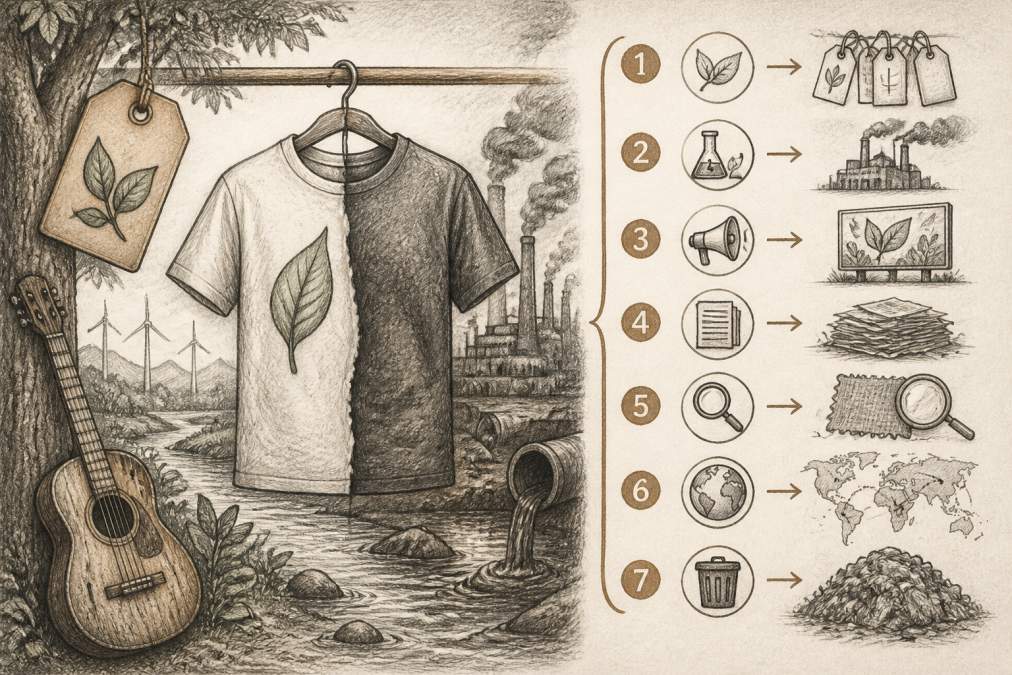
Greenwashing in fashion is making a brand appear more environmentally or ethically responsible than its operations, sourcing, or labor practices support. It shows up in vague labels, unverifiable claims, and imagery that signals sustainability without evidence.
The stakes are real. The Federal Trade Commission's Green Guides give marketers specific rules about environmental claims, and the agency has updated its guidance to target exaggerated or unqualified "green" language. When a shirt says "eco-friendly" with no proof, that is not a small marketing shortcut. It is a claim regulators can challenge.
Rasta Hippies has spent years working with handcrafted, small-batch apparel, and the difference between a genuine sustainability story and a marketing one comes down to one thing: whether the brand can show its work. Below: the red flags, the terms to distrust, the certifications that hold up, and a method for checking any brand before you buy.
The Seven Sins of Greenwashing
TerraChoice, an environmental marketing firm, named the "Seven Sins of Greenwashing" to categorize the most common misleading claims:
- Hidden trade-off - a product promoted as green based on one attribute while ignoring a bigger problem elsewhere
- No proof - a claim that cannot be substantiated or verified
- Vagueness - language so broad it is essentially meaningless
- False labels - fake certification imagery or invented seals
- Irrelevance - a true claim that does not matter to the actual environmental question
- Lesser of two evils - a technically true claim that distracts from the category's harm
- Fibbing - outright false statements
Most misleading fashion marketing leans on sins two, three, and six: a fabric called "natural" without proof, a term too vague to verify, and a minor improvement used to avoid the bigger question of how the garment was made.
Vague Sustainability Marketing Terms to Watch For
Vague sustainability marketing terms have no agreed definition, no required verification, and no legal weight. They make a product look responsible without saying anything checkable. Treat them as a prompt to ask for specifics, not as evidence.
| Vague Term | What It Suggests | What to Look For Instead |
|---|---|---|
| "Eco-friendly" | Low environmental harm | A named certification or standard |
| "Natural" | Plant-based or unprocessed | The specific fiber and its source |
| "Green" | Environmentally sound | A measurable claim with a number |
| "Sustainable" | Long-term viable | A lifecycle assessment or audit |
| "Conscious" | Ethically made | Named factories and wage disclosure |
| "Planet-positive" | Net environmental benefit | A verified offset or reduction figure |
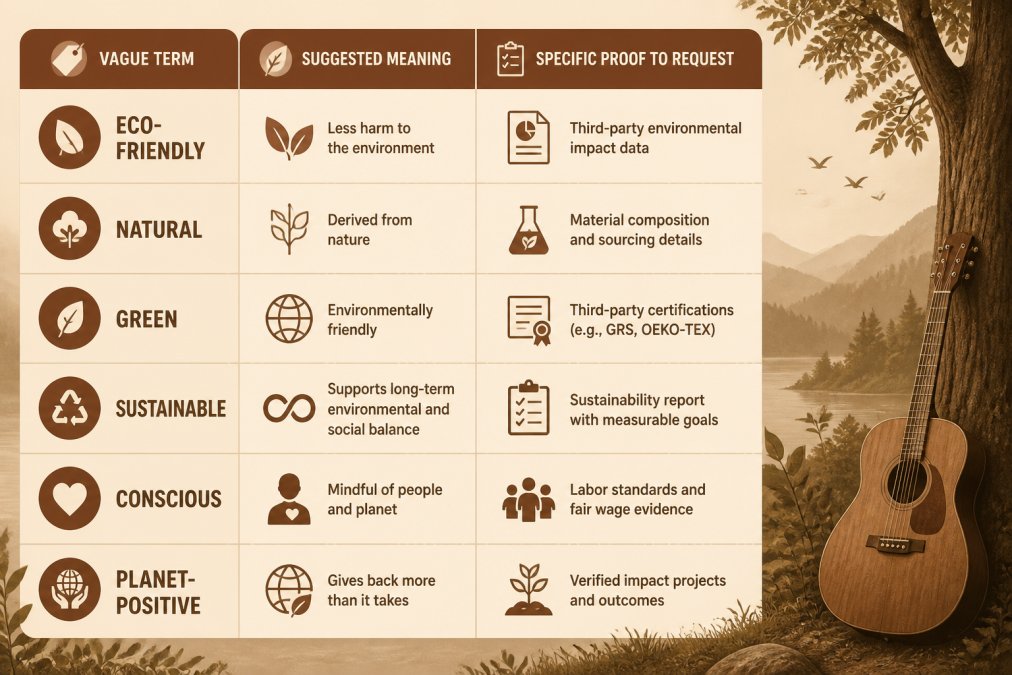
The pattern is the same: the word does the emotional work and the buyer assumes the rest. A brand that genuinely sources responsibly names the standard, the fiber, or the factory; one that does not reaches for adjectives.
A Sustainable Fashion Certifications List You Can Trust
A trustworthy sustainable fashion certifications list includes third-party programs that audit supply chains and verify claims independently, because self-reported sustainability is not verifiable. Each covers a different part of the production chain, so one garment may carry several.
- GOTS (Global Organic Textile Standard) - verifies organic fiber content and processing standards
- OEKO-TEX Standard 100 - tests finished textiles for harmful substances
- Bluesign - screens chemicals and processes in textile manufacturing
- Fair Trade Certified - confirms fair wages and safe working conditions
- GRS (Global Recycled Standard) - verifies recycled content and chain of custody
- B Corp Certification - assesses a company's overall social and environmental performance
- Cradle to Cradle - evaluates materials for circular economy design
The key word is third-party. A logo a brand designs itself is not a certification. Check the certifying body's own website to confirm the brand appears in its database; fake seals are one of the oldest tricks in the book.
Examples of Greenwashing in Clothing Brands
Examples of greenwashing in clothing brands follow recognizable patterns rather than one-off mistakes. The most common is a "conscious" or "eco" collection launched alongside a much larger conventional line, with the sustainable capsule a small fraction of total output.
Another frequent pattern is the token eco-collection: a handful of recycled-fiber pieces in marketing imagery while the bulk of production relies on conventional synthetics. The collection is real; the impression that the whole brand has changed usually is not.
Fast fashion brands are the most scrutinized here because their business model depends on volume and speed. Overproduction, deadstock, and rapid trend cycles sit uneasily next to sustainability messaging, and critics argue the two cannot fully coexist. Regulators have taken notice. The Federal Trade Commission's Green Guides set the baseline for what environmental claims are allowed, and the agency has brought enforcement actions against apparel and textile marketers whose "green" language could not be substantiated. State attorneys general have also pursued cases under consumer protection statutes, treating unqualified sustainability claims as deceptive advertising.
Material-specific greenwashing is subtler. A brand promotes "recycled polyester" without noting the garment still sheds microplastics, or highlights "organic cotton" for a single trim while the main body is conventional. A related trick is the "bio-based" label on a fabric only partially plant-derived, with the rest petroleum-based synthetics.
Here is how the most common patterns map to the Seven Sins framework:
| Pattern | What the Brand Says | What Is Actually Happening | Sin |
|---|---|---|---|
| Token eco-collection | "Our sustainable line" | Capsule is a tiny share of total output | Lesser of two evils |
| Recycled polyester halo | "Made from recycled plastic" | Microplastic shedding and virgin fiber blends go unmentioned | Hidden trade-off |
| Organic trim | "Organic cotton details" | Main body is conventional cotton or synthetic | Hidden trade-off |
| Carbon-neutral shipping | "Climate-neutral delivery" | Offsets substitute for emissions reductions | Vagueness / Irrelevance |
| Self-designed seal | A leaf logo on the tag | No third-party audit behind it | False labels |
| "Conscious" capsule | "Mindfully made" | No factory names, no wage data | No proof |
Watch the gap between a brand's marketing and its public policy positions. Some apparel companies run sustainability campaigns while their trade associations lobby against disclosure rules that would make those campaigns verifiable. That contradiction is one of the clearest signals that the marketing is doing work the operations are not.
Step-by-Step: How to Spot Greenwashing in Fashion Before You Buy
Spotting greenwashing in fashion comes down to a repeatable verification routine. Run any brand through these steps before checkout, and most misleading claims surface quickly.
Total time: 10-15 minutes per brand
- Check the claim's specificity [Time: 2 minutes]. Vague adjectives are a red flag. Look for a number, a standard, or a named material. "50% recycled cotton" beats "eco-friendly."
- Verify the certification [Time: 3 minutes]. Go to the certifying body's website and confirm the brand is listed. Do not trust a logo on a product page alone.
- Read the materials list [Time: 2 minutes]. Note the actual fiber percentages. A "sustainable" garment that is mostly virgin synthetic is not what the marketing implies.
- Look for supply chain disclosure [Time: 3 minutes]. Brands that know their factories usually name them. Absent sourcing information is a signal.
- Cross-check labor practices [Time: 2 minutes]. Fair wages and safe conditions are part of sustainability. A garment made responsibly for the planet but not the people is only half the story.
- Scan for the token collection [Time: 2 minutes]. If the "green" line is tiny next to the conventional catalog, the sustainability is likely marketing, not a business model.
Expected result: A shortlist of brands whose claims you can actually verify, and a clear pass on the ones that only sound responsible.
The Greenwashing Calculator
A simple scoring method turns those steps into a quick verdict. Score each brand from 0 to 2 on five questions, then total the points.
| Question | 0 Points | 1 Point | 2 Points |
|---|---|---|---|
| Named certification? | None | Self-declared | Third-party verified |
| Materials disclosed? | No | Partial | Full percentages |
| Supply chain named? | No | Vague | Factories listed |
| Labor standards shown? | No | Claim only | Certified |
| Claims specific? | Vague | Mixed | Numbers and standards |
A total of 8-10 points signals a brand worth trusting. A score of 4-7 means more digging is needed. Anything below 4 is a strong greenwashing signal.
Digital Product Passports: The New Transparency Tool
Digital Product Passports (DPP) are scannable records carrying a garment's full history, from raw material sourcing through manufacturing, repair, and recycling. A shopper scans a code on the tag, usually a QR code or NFC chip, and sees verified data on origin, fiber composition, chemical inputs, and environmental impact. The record travels with the product, not the marketing page.
This is the biggest shift in fashion transparency in years, and most buying guides have not caught up. DPP requirements are emerging through circular economy regulations pushing brands to disclose traceability, lifecycle data, and end-of-life handling. The European Union's Ecodesign for Sustainable Products Regulation is the most advanced framework, with textiles among the first categories slated for passport requirements. Similar mandates are being debated elsewhere, and international brands are preparing regardless of headquarters.
For a shopper, the value is simple: instead of trusting a sustainability page a brand wrote about itself, you read a structured record of verifiable data. A passport is hard to fake because the information must reconcile across the supply chain, and easy to verify because the standards behind it are public.
What a passport typically covers:
- Fiber composition - actual percentages, not marketing names
- Origin of materials - where the cotton, wool, or recycled feedstock came from
- Manufacturing facilities - the factories and their locations
- Chemical inputs - dyes, finishes, and restricted substances
- Durability and repairability - expected lifespan and repair options
- End-of-life instructions - how to recycle or return the garment
For now, DPP adoption is uneven. Some brands are piloting scannable tags; others are waiting for requirements to firm up. When a brand offers one, it is a meaningful signal. When a brand markets heavily on sustainability but offers no traceability, that gap tells its own story.
The Angle Most Guides Miss: Lobbying vs. Marketing
The transparency tools above only work if the rules behind them survive, and that is where the sharpest greenwashing signal lives. Some brands run green marketing campaigns while quietly opposing the disclosure rules that would make their claims checkable. Trade associations funded by apparel companies have lobbied against extended producer responsibility laws, mandatory supply chain reporting, and chemical disclosure requirements.
A brand's public position on disclosure rules is often more honest than its product labels. If a company publishes a sustainability report but its trade group fights traceability mandates, the report is public relations, not accountability. Check a brand's lobbying disclosures, trade association memberships, and public comments on proposed regulations; the pattern is usually visible within an hour.
Conclusion
The gap between sustainable fashion marketing and verifiable practice is closing slowly, and shoppers still carry most of the burden of checking. The brands that earn lasting trust name their certifications, disclose their supply chains, and welcome tools like Digital Product Passports instead of avoiding them.
RastaHippies.com builds apparel around that same idea: original art, handcrafted merchandise, and a commitment to donating to charitable foundations dedicated to ocean and environmental conservation, including support tied to partners like the Rob Machado Foundation and Kōkua Hawaiʻi Foundation. For shoppers who want designs rooted in peace, music, and nature without the vague claims, RastaHippies.com offers a place to start. Explore the collection and see the difference a brand that shows its work makes.
Frequently Asked Questions
What are some good ways to spot greenwashing?
Look for specific, verifiable claims instead of vague words like 'eco-friendly' or 'natural.' Check for third-party certifications such as GOTS or Bluesign on the label. Trace the supply chain: if a brand cannot name its factories or raw material sources, that is a red flag. Watch for hidden trade-offs, like a 'recycled' shirt made in a coal-powered factory. Compare the marketing language against the brand's actual environmental impact report, and see whether the sustainability claim applies to one product line or the whole company.
What are the most common vague sustainability marketing terms used in greenwashing?
The worst offenders are 'eco-friendly,' 'green,' 'natural,' 'conscious,' 'responsible,' and 'planet-positive.' None of these have a legal definition in the United States, so a brand can use them without proof. 'Recycled' is another tricky one: it might mean 5% recycled content or 100%, and the rest could be virgin polyester. 'Biodegradable' often only breaks down in industrial composting facilities that most cities do not have. If a term cannot be measured or verified, treat it as marketing noise.
How do third-party certifications help identify greenwashing?
Certifications like GOTS, Fair Trade Certified, Bluesign, and Cradle to Cradle require independent audits of supply chains, chemical use, and labor practices. They set specific thresholds a brand must meet, so a company cannot simply claim compliance. When you see a certification logo, check the certifier's website to confirm the brand and product are actually listed. A brand that invents its own in-house 'green seal' without external verification is a major warning sign. Real certifications are verifiable and traceable.
Does a 'recycled' label always mean a garment is eco-friendly?
No. A 'recycled' label only tells you part of the story. The garment might contain 10% recycled cotton and 90% virgin polyester, or the recycling process itself could be energy-intensive. Check the percentage of recycled content and what the remaining materials are. Also look at where and how it was made: a recycled fiber shirt sewn in a factory with poor labor practices is not truly sustainable. Look for certifications that verify both the recycled content and the manufacturing conditions.