 how-to
How to Verify Environmental Charity Donations (2026 Guide)
Table of Contents
- Step 1: How to Check if a Charity Is Legitimate
- Step 2: Understanding Environmental Charity Ratings
- Step 3: How to Verify Where Charity Donations Go
- Step 4: Assessing Environmental Impact Claims
- Step 5: Charity Donation Scam Warning Signs
- Step 6: Verifying Donation Links, Fundraisers, and Payment Requests
- What to Do When Information Is Missing or a Check Fails
- Frequently Asked Questions
Last Updated: October 12, 2026
Step 1: How to Check if a Charity Is Legitimate
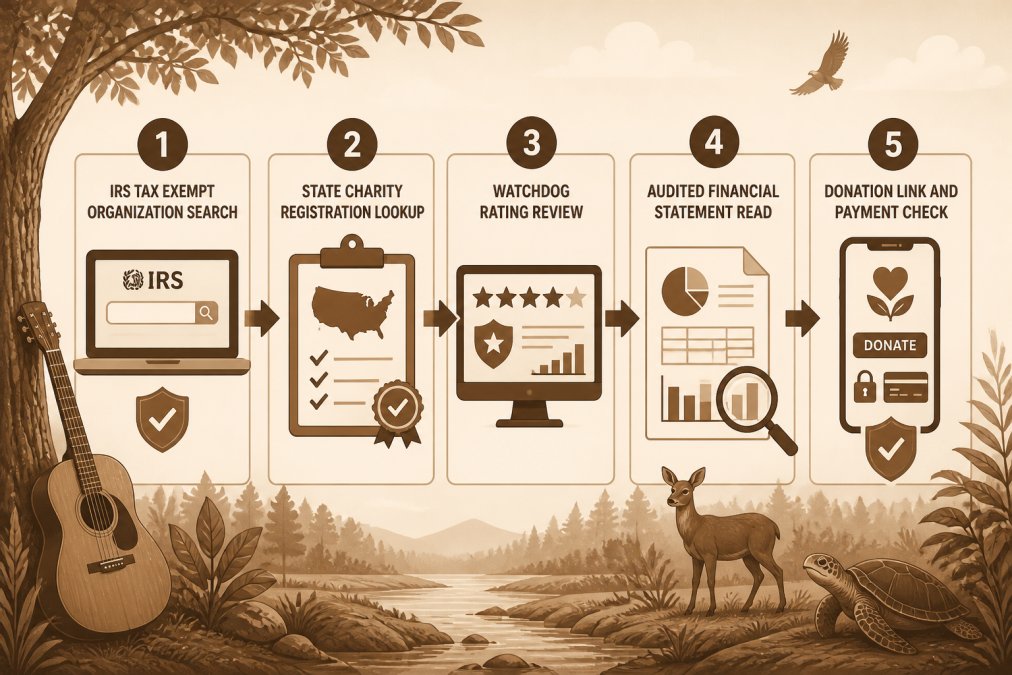
Learning how to verify environmental charity donations starts with one simple rule: confirm the group is a registered nonprofit before any money leaves your hands. A legitimate environmental charity is a registered tax-exempt organization that files public paperwork and can prove where its money goes. This guide from RastaHippies.com walks through a six-step check any donor can run in under an hour.
Confirm Tax-Exempt Status and Registration
Start with the IRS. The IRS Tax Exempt Organization Search tool lets anyone confirm whether a group holds 501(c)(3) status. That status matters for two reasons: donations may be tax-deductible, and the charity must file an annual return. If a group is not listed, treat that as a stop sign.
Review Public Filings and State Registrations
Most states require charities to register before soliciting donations. A quick check of the state attorney general or charity regulator website shows whether a group is current on its filings. Groups that skip registration often skip other rules too.
Step 2: Understanding Environmental Charity Ratings
Watchdog ratings are a fast filter, not a final answer. The three groups most donors encounter are Charity Navigator, Candid (which maintains the GuideStar profiles), and the BBB Wise Giving Alliance. Each scores charities on financial health, transparency, and governance, and each publishes its methodology on its own site, so you can see exactly what a given score rewards before you trust it.
What Watchdog Ratings Measure (and What They Miss)
Ratings lean heavily on financial ratios: the share of revenue spent on programs versus administration and fundraising, growth in revenue and programs over time, and whether the organization publishes its key documents. Charity Navigator, for example, has historically built its star scale around such accountability and finance measures, while the BBB Wise Giving Alliance evaluates against a set of standards covering governance, effectiveness, and truthfulness in fundraising. Candid's profiles are less a score than a transparency record: a charity that files complete, current information earns a higher seal.
What none of them reliably measure is whether a specific conservation project worked. A four-star score tells you the books look clean and the paperwork is current, not that the trees got planted or the reef recovered. That gap matters more for environmental groups than for almost any other category, because so much of the work is field-based and slow to show results.
Why a Single Overhead Ratio Misleads on Conservation Work
A common donor shortcut is to reject any charity spending "too much" on overhead. For environmental organizations, that shortcut backfires. A land trust may need legal and title work to secure a conservation easement. A restoration group may spend heavily on monitoring equipment, permits, and scientist time before a single acre improves. A policy-focused group may direct most of its budget to advocacy and research, which shows up as non-program spending on some filings even though it is the mission.
A more useful read is the trend, not the snapshot: is program spending rising over several years, is the organization accumulating an unreasonable reserve, and does the narrative in the annual report match the numbers in the audit? Pair the rating with the filings in Step 3 before you decide.
Step 3: How to Verify Where Charity Donations Go
A simple answer: read the audited financial statements. Every registered nonprofit files an annual report, and most post it on their own website. The audit shows total revenue, program spending, and administrative costs. If a charity cannot produce an audit, that alone tells you something.
Reading Audited Financial Statements and Annual Reports
Look for three lines first: program spending, fundraising expenses, and administrative expenses. Then read the notes section, which explains anything unusual. A healthy environmental charity puts the bulk of its budget into programs, not overhead.
| Document | What It Shows | Where to Find It |
|---|---|---|
| IRS Form 990 | Revenue, expenses, salaries | IRS website |
| Audited financials | Independent review of books | Charity's own site |
| Annual report | Programs and outcomes | Charity's own site |
| State registration | Legal standing to solicit | State regulator site |
Step 4: Assessing Environmental Impact Claims
Impact claims deserve the same scrutiny as financials, and environmental claims are the hardest to check because the results unfold over years and across landscapes. A charity that says it "protects the ocean" should name the specific projects, locations, and results. Vague language about "awareness" or "advocacy" is hard to measure and easy to repeat.
The strongest environmental claims share four traits. Use them as a scorecard.
1. A Baseline
A credible claim starts from a measured starting point. "We planted 50,000 trees" means little without knowing how many were there before, what species, and where. "We restored 300 acres of native grassland that had been converted to row crops, up from 40 acres of remnant prairie" gives you something to check. If no baseline appears anywhere in the annual report or project page, the number is decoration.
2. A Defined Timeframe
Conservation outcomes are slow. A claim that a project "reduced emissions" or "recovered a species" should say over what period and against what target. One-year results in a ten-year restoration are a progress note, not an outcome. Look for multi-year reporting that shows the same metric tracked across several annual reports.
3. A Named Metric and Method
Different environmental goals need different measures: acres protected, tons of carbon sequestered, miles of stream restored, species counts, water-quality readings, or policy outcomes. A serious organization names the metric and explains how it was collected, field surveys, satellite imagery, third-party audits, or government data. If the method is never described, treat the number as a marketing figure.
4. Independent Verification
Ask who checked the numbers. The strongest answers point to an outside evaluator: a university research partner, a government agency, a third-party certification, or an independent audit of the impact report itself. Self-reported results are common and not automatically suspect, but they carry less weight than externally reviewed ones.
Red Flags in Environmental Claims
- Round numbers with no source ("millions of trees," "thousands of acres")
- Claims that shift every year with no comparison to prior results
- Photos of a project with no location, date, or partner named
- "Carbon neutral" or "net zero" language with no methodology or verification standard cited
- Impact described only in terms of money spent rather than outcomes achieved
Ask the charity directly for the underlying data. A group doing real work usually has it and is glad to share. A group that deflects is telling you something.
Step 5: Charity Donation Scam Warning Signs
Scammers copy real charity names and pressure donors fast. The FTC guidance on charity scams warns that urgent appeals, gift card requests, and unfamiliar payment apps are common red flags. Real charities do not demand payment in gift cards or crypto.
Watch for these signs:
- Pressure to give right now
- Payment only by gift card, wire, or crypto
- No registration or tax ID number
- A name that closely copies a known group
- No way to reach a real person
Step 6: Verifying Donation Links, Fundraisers, and Payment Requests
Donation links and third-party fundraisers need a check before you click. Crowdfunding pages are not charities. The person running the page may be a well-meaning individual, but your gift may not be tax-deductible and may not reach the cause.
Verify by matching the link to the charity's own domain. If a fundraiser claims to support a group, call or email that group and ask if the campaign is authorized. A quick confirmation call stops most fraud.
What to Do When Information Is Missing or a Check Fails
Missing information is itself information. If a charity has no audit, no registration, or no clear program numbers, do not donate. Instead:
- Ask the charity directly for its latest audit and 990.
- Give the group a short window to respond.
- If answers do not come, choose a different organization.
A failed check is not a dead end. Plenty of verified environmental charities need support right now.
Choosing where to send your money takes a little work, but it protects both your gift and the cause you care about. RastaHippies.com supports ocean and environmental conservation through partnerships with groups like the Rob Machado Foundation and Kōkua Hawaiʻi Foundation, and the brand's apparel and handcrafted designs give supporters a way to wear their values. Every purchase helps fund that mission while celebrating Reggae, Rasta, and Hippie culture. Visit RastaHippies.com to shop the collection and support verified conservation work.
Frequently Asked Questions
How do I check if an environmental charity is legitimate before donating?
Start with the IRS Tax Exempt Organization Search to confirm 501(c)(3) status. Then check your state's charity regulator for registration. Look for accreditation from the BBB Wise Giving Alliance or Charity Navigator ratings. Review the charity's most recent Form 990, which shows revenue, expenses, and program spending. Legitimate environmental charities will have consistent contact information, clear leadership names, and a physical address. If any of these details are missing or inconsistent, treat it as a red flag and dig deeper before giving.
What are the warning signs of a charity donation scam?
Common scam warning signs include pressure to donate immediately, requests for payment via gift cards, wire transfers, or cryptocurrency, and refusal to provide written information about the organization. Be cautious of charities with names that sound similar to well-known organizations, since scammers often use confusingly similar names. Other red flags: no tax-exempt status, no physical address, vague descriptions of how funds are used, and unsolicited donation requests that arrive by text or social media direct message. Always verify independently before giving.
Are charity ratings enough to verify an environmental organization?
Ratings from watchdogs like Charity Navigator and BBB Wise Giving Alliance are a useful starting point, but they focus heavily on financial ratios and accountability. They do not measure whether an environmental charity's programs actually work. A charity can score well on overhead ratio yet run ineffective conservation programs. Use ratings as one input alongside your own review of annual reports, program outcomes, and independent evaluations. For environmental groups specifically, check whether they publish measurable results like acres protected, species recovered, or emissions reduced.
How can I verify where my charity donation actually goes?
Request the charity's most recent annual report and audited financial statements. The Form 990 filed with the IRS breaks down revenue and expenses into program services, administrative costs, and fundraising. Look at the program spending ratio to see how much goes to actual charitable work versus overhead. You can also check the charity's website for impact reports that describe specific projects and outcomes. If a charity cannot or will not show you where the money goes, that is a significant warning sign. Reputable organizations publish this information freely.