 how-to
Custom Rasta Logo Design Services: 2026 How-To Guide
Table of Contents
- What Custom Rasta Logo Design Services Actually Deliver
- Rasta Logo Design Ideas: Symbols, Colors, and Visual Styles
- Step-by-Step: The Logo Design Process from Brief to Delivery
- Stage 1: Define Brand Values Before You Contact Anyone
- Stage 2: Write the Brief (One Page, Not Five)
- Stage 3: Shortlist Designers with a Scorecard
- Stage 4: Review Concepts Against the Brief, Not Your Mood
- Stage 5: Request Revisions in One Consolidated Round
- Stage 6: Receive Final Files and Confirm Rights
- How Long the Whole Process Takes
- How to Write a Logo Design Brief Template That Gets Results
- Vector Logo Files and Formats You Need for Print and Digital
- Pricing, Scope, and What Drives Cost in Logo Projects
- Common Mistakes to Avoid When Commissioning a Rasta Logo
- Frequently Asked Questions
Last Updated: October 12, 2026
What Custom Rasta Logo Design Services Actually Deliver
A custom rasta logo design service delivers original artwork built around Rastafari-inspired symbols, colors, and typography, then hands over production-ready files you own.
Custom rasta logo design services is the umbrella term for agencies, independent designers, and contest platforms that create original Rastafari-themed logos on commission. The key word is original: artwork made for you, not a template thousands of others have downloaded.
Self-Service Makers vs. Commissioned Designers
Self-service logo makers let you pick a template and customize it in minutes; commissioned designers build from scratch, and that difference shows up in ownership, uniqueness, and how well the mark holds up across applications. Commissioned work costs more and takes longer, but you get a concept shaped around your specific story plus a designer who can explain why each choice works.
What a Complete Logo Package Should Include
A complete package covers far more than one image file. Confirm the deliverables in writing before you commit.
- Primary logo in full color
- One-color and reversed versions for dark backgrounds
- Horizontal and stacked layouts
If a provider can't list these, ask why. Missing formats cause expensive rework when a printer or sign maker needs a file you don't have.
Rasta Logo Design Ideas: Symbols, Colors, and Visual Styles
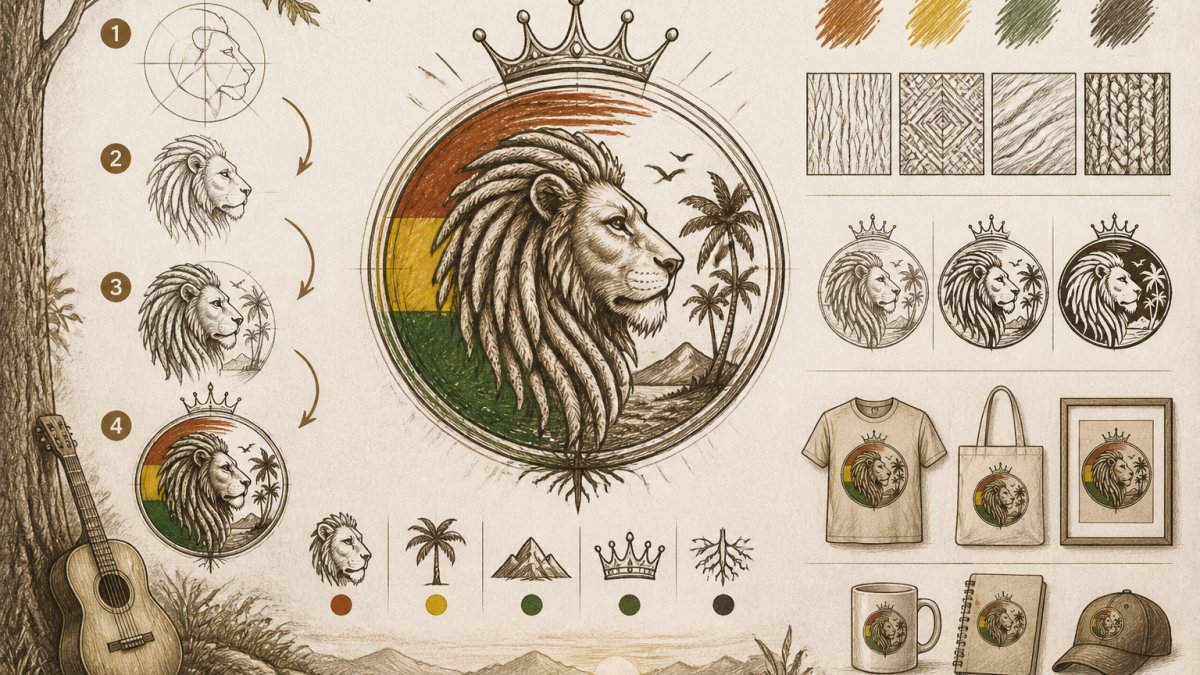
Strong Rasta logo design ideas pull from a recognizable visual language: the red, gold, and green palette, the Lion of Judah, the Star of David, the Ethiopian flag motif, and natural textures like wood, hemp, and woven fabric. The best marks use one or two of these elements, not all at once, cluttered logos lose impact at small sizes, where a single lion silhouette reads but a lion, leaf, drum, and flag together turn into noise.
Cultural Context and Respectful Use of Rastafari Symbols
Rastafari symbols carry real spiritual and historical meaning: the colors trace to the Ethiopian flag and the movement's roots in Jamaica, and the Lion of Judah represents Haile Selassie I and a specific theological tradition. Using these elements as pure decoration can read as disrespectful to the community the brand claims to serve, so a thoughtful brief explains why each symbol belongs in your identity.
Typography and Color Treatments That Work
Typography sets the tone as much as imagery does, ranging from bold hand-lettered scripts to clean geometric sans-serifs, and the choice should match how the brand wants to be perceived. Color treatments need contrast to survive in the real world: a logo that only works in full color fails on a black t-shirt or a single-color stamp, so test a one-color version early.
- Bold lettering: reads well on apparel and signage
- Hand-drawn type: signals craft and authenticity
- Clean sans-serif: suits modern wellness and lifestyle brands
Step-by-Step: The Logo Design Process from Brief to Delivery
The logo design process runs through six stages: define brand values, write the brief, shortlist designers, review concepts, request revisions, and receive final vector files.
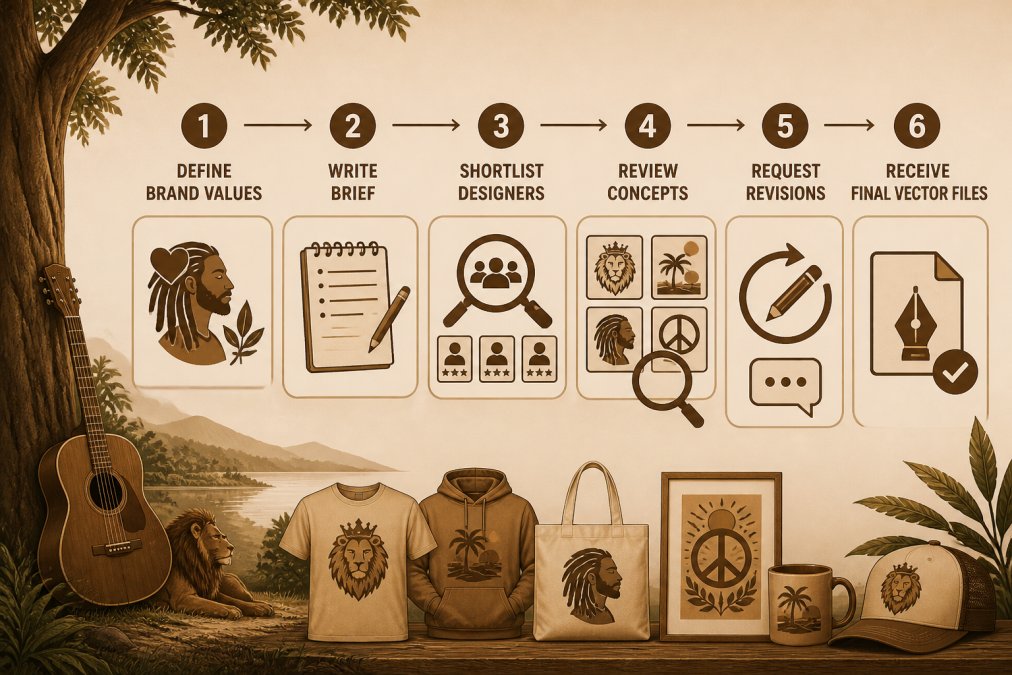
- Define brand values. Write down what the brand stands for in plain language. If you can't explain it in two sentences, a designer can't visualize it.
- Write the brief. Capture audience, tone, symbols, colors, deliverables, and what you do NOT want. One page is the target.
- Shortlist designers. Review portfolios for relevant style and cultural fluency. Ask whether they've worked with Rastafari-inspired or culturally specific marks before.
- Review concepts. Expect two to four directions, not twenty. More options usually means less thinking per option.
- Request revisions. Consolidate feedback into one numbered round rather than many scattered notes.
- Receive final files. Confirm every format and the rights transfer before the final payment.
Stage 1: Define Brand Values Before You Contact Anyone
Before you open a single designer's portfolio, write down three things: what the brand does, who it serves, and the feeling the logo should trigger at a glance. A wellness line selling herbal teas wants calm and earthiness; a sound system or band wants energy and movement; a skate or surf shop wants grit and motion.
Stage 2: Write the Brief (One Page, Not Five)
A tight brief is the single highest-leverage document in the project, covering audience, tone, symbols to consider and avoid, color direction, where the logo will appear, deliverables, timeline, budget range, and reference links, all on one page, since a five-page brief buries the details that drive design decisions. Include a line about what the brand does NOT want: designers consistently say negative direction saves more time than positive direction, because it rules out whole categories of concepts before they're drawn.
Stage 3: Shortlist Designers with a Scorecard
Don't shortlist on price alone. Score each candidate on portfolio relevance, cultural fluency (do they understand Rastafari symbolism or are they willing to learn?), communication (do they ask clarifying questions before quoting?), and deliverable depth (do they list vector files and a style guide?). A designer who asks three good questions before quoting is usually a better hire than one who quotes in five minutes.
Stage 4: Review Concepts Against the Brief, Not Your Mood
When concepts arrive, evaluate each against the written brief rather than personal taste. Ask three questions per concept: Does it communicate the right feeling at a glance?
Expect two to four directions from a serious designer. Twenty usually means variations rather than distinct concepts; one means you should ask whether alternatives were considered.
Stage 5: Request Revisions in One Consolidated Round
Bundle feedback into a single, numbered list. Designers work faster with clear direction than with scattered messages, so name what works and what doesn't and explain the reasoning, "the lion feels too aggressive for a wellness brand" beats "I don't like it." Most contracts include two or three revision rounds, and going beyond that often triggers extra fees, so raise concerns early; if you reach round five, the brief was probably too vague.
Stage 6: Receive Final Files and Confirm Rights
Before the final payment, confirm you have received every format listed in the brief: vector source files (AI, EPS, or SVG), web-ready exports (PNG with transparent background, JPEG for previews), a PDF for sharing, and a short style guide with color codes and font names. Confirm in writing that the contract transfers ownership and confirms originality.
How Long the Whole Process Takes
Rush timelines are usually possible for an added fee, but they leave less room for the cultural research that a Rasta-themed mark benefits from.
How to Write a Logo Design Brief Template That Gets Results
A logo design brief is a short document that tells a designer what the brand stands for, who it serves, and what the finished logo must do. A tight brief cuts revision cycles and produces concepts that land closer to the target on the first pass.
Here is a fill-in-the-blank template you can adapt:
Brand name: [your name] What we do: [one sentence] Audience: [who buys from you] Three words that describe us: [word], [word], [word] Symbols we want considered: [e.g., lion, leaf, drum] Symbols to avoid: [anything off-limits] Color direction: [palette notes] Where the logo will appear: [shirts, signage, web, packaging] Deliverables needed: [vector, PNG, PDF, style guide] Timeline and budget range: [dates and range] Designers we admire: [links for reference]
Keep it to one page. A brief that runs five pages buries the important details.
Vector Logo Files and Formats You Need for Print and Digital
Vector logo files are resolution-independent artwork built from mathematical paths, so they scale to any size without losing sharpness. Every logo package should include vector source files plus ready-to-use exports.
| Format | Best For | Editable? |
|---|---|---|
| AI | Designers, print production | Yes |
| EPS | Older print workflows, sign makers | Yes |
| SVG | Websites, apps, responsive design | Yes |
| Sharing, print, contracts | Sometimes | |
| PNG | Web, social media, transparent backgrounds | No |
| JPEG | Quick previews, documents | No |
Ask for the vector source files (AI, EPS, or SVG) as part of the package. Without them, you can't resize the logo for a banner or a billboard without pixelation.
Pricing, Scope, and What Drives Cost in Logo Projects
Logo pricing varies widely because scope varies widely. A contest platform, a template maker, and a full-service agency all sell something different, even though each calls the result a logo. Here are the cost drivers so you can compare apples to apples.
The Four Common Pricing Models
- Template and logo-maker tools. Subscription or one-time download. Fast and cheap, but the mark is not exclusive, other buyers can license the same template.
- Contest platforms. You post a brief and multiple designers submit. You pay only if you pick a winner, but quality varies and the winner may not be available for follow-up work.
- Independent designers. Flat project fee, usually quoted after a short discovery call. Best for small businesses that want one strong mark without agency overhead.
What Actually Drives the Price
Six factors move the number more than anything else:
- Number of concepts. One concept is cheaper than four, and four is cheaper than a full exploration.
- Revision rounds. Two rounds is standard; unlimited revisions sounds generous but usually means the brief was weak.
- Deliverable depth. A single PNG is not the same product as a vector package with a style guide, business card layout, and social templates.
- Rights and exclusivity. Full copyright transfer with a guarantee of originality costs more than a limited license.
- Turnaround speed. Rush timelines carry premiums because they displace other work.
- Cultural fluency. A designer who already understands Rastafari symbolism needs less back-and-forth, which can reduce total cost even at a higher hourly rate.
Licensing, Rights, and Originality
Read the contract for three things: who owns the copyright after delivery, whether the designer guarantees the mark is original and not derived from existing work, and whether the designer retains portfolio display rights. Full transfer of rights is standard for custom commissions but not universal, some low-cost providers license the mark rather than selling it outright.
Timelines and How They Affect Cost
Rush timelines are usually possible for an added fee, but they leave less room for the cultural research a Rasta-themed mark benefits from.
How to Compare Quotes Fairly
Put every quote into the same table: number of concepts, revision rounds, deliverables, rights terms, timeline, and total cost. A quote that looks higher on the first line often wins once you add the cost of redrawing a missing vector file or buying extra revisions.
Common Mistakes to Avoid When Commissioning a Rasta Logo
The biggest mistake is skipping the brief. Without written direction, designers guess, and you pay for revisions a one-page document would have prevented.
Other frequent problems:
- Chasing the lowest price. The cheapest option often excludes vector files, so you pay again later for redraws.
- Requesting too many symbols. A logo with five elements reads as a blur at small sizes.
- Ignoring cultural context. Treating sacred symbols as decoration alienates the audience you want.
Commissioning a Rasta logo means finding a designer who respects the culture behind the symbols as much as you do. RastaHippies.com builds original Rastafari-inspired art and offers personalized logo and web design rooted in positive energy, with every project supporting ocean and environmental conservation through partners like the Rob Machado Foundation and Kōkua Hawaiʻi Foundation.
Frequently Asked Questions
How much do designers charge to create a custom Rasta logo?
Pricing depends on the designer's experience, project scope, and the number of concepts and revisions included. Entry-level packages can start low, while full branding engagements cost more. For a custom Rasta logo design services project, request a written quote that itemizes concept rounds, revision limits, and final file formats before you commit.
What files should I request from a logo designer?
Ask for vector logo files in AI, EPS, SVG, and PDF formats for scalability and print production. Also request high-resolution PNG and JPEG versions for web use. A vector file lets you resize the logo to any dimension without losing quality, whether it goes on a business card or a billboard. Confirm in writing that you receive full commercial use rights and a brand style guide showing color codes and typography.
How do I make sure a Rasta-inspired logo feels authentic and respectful?
Work with a designer who understands Rastafari culture rather than treating it as a visual trend. Share references that show how the colors, symbols, and typography are used in context. Avoid mixing sacred imagery with unrelated commercial elements. A logo design brief template that includes a cultural sensitivity section helps the designer understand your intent, so the final mark honors the community rather than appropriating it.
Can I use AI to create a custom Rasta logo instead of hiring a designer?
AI logo makers offer Rastafari-themed templates you can customize and download. They work for quick, low-budget projects. However, AI-generated logos may lack originality and can raise copyright concerns. A commissioned designer provides a unique concept, vector logo files, and a brand style guide that supports long-term brand identity across print and digital applications.