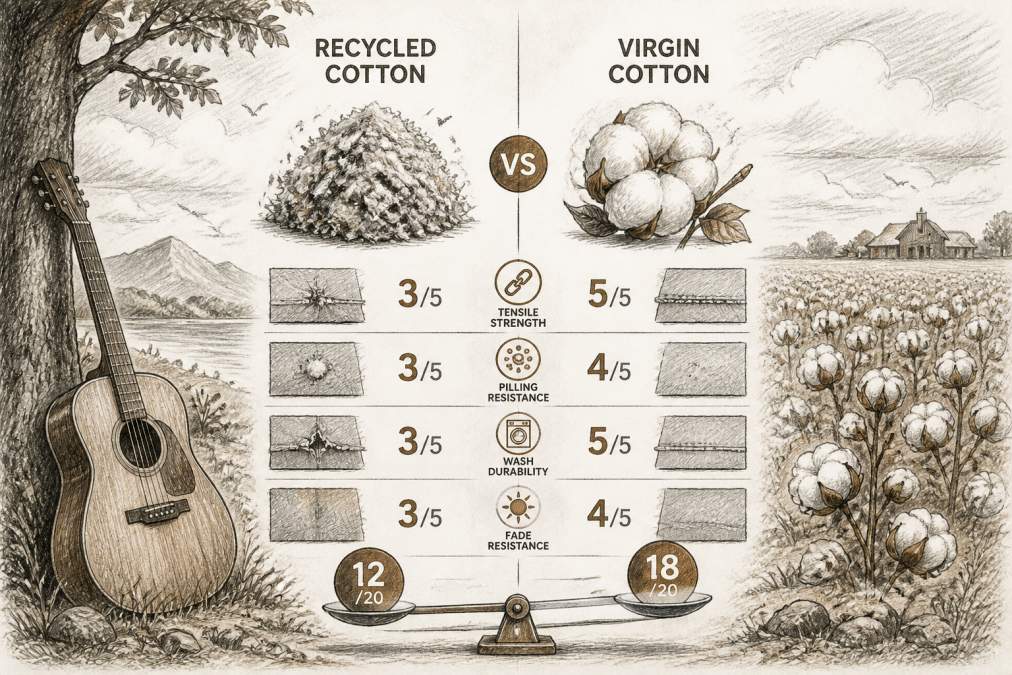
 comparison
Recycled Cotton vs Virgin Cotton: Durability Guide
Table of Contents
- Why Recycled Cotton Durability Differs from Virgin Cotton
- Recycled Cotton vs Virgin Cotton Durability: A Technical Comparison
- Durable Eco-Friendly T-Shirts for Everyday: What to Look For
- How to Care for Recycled Cotton Garments
- Environmental Impact and Cost Considerations
- Frequently Asked Questions
Last Updated: September 15, 2026
Why Recycled Cotton Durability Differs from Virgin Cotton
Recycled cotton vs virgin cotton durability comes down to one physical fact: recycling shortens cotton fibers, and shorter fibers produce weaker yarn. Virgin cotton grows as long, unbroken staple fibers that spin into strong thread. Recycled cotton arrives as already-cut material, so its fibers are shorter before spinning even begins. That single difference explains most of the performance gap buyers notice after a few washes.
This guide from RastaHippies.com breaks down where that gap is real, where blending closes it, and what to check before buying.
Recycled cotton is cotton fiber recovered from post-industrial scraps or post-consumer textiles, then re-spun into new yarn rather than grown from a new crop. The recovery method matters as much as the fiber itself.
The Mechanical Recycling Process and Fiber Shortening
Mechanical recycling is the most common route. Textile waste is sorted by color, shredded, and carded back into spinnable fiber. No chemicals break the material down, which keeps the process low-impact and cheap.
The trade-off is fiber shortening. Shredding cuts long staple fibers into shorter pieces, and shorter staple length means fewer contact points per thread. Fewer contact points means lower tensile strength and more pilling at the surface.
Mechanical vs. Chemical Recycling: Impact on Fiber Integrity
Chemical recycling dissolves cotton back to its cellulose and re-spins it, which preserves fiber length far better than shredding. The catch is cost and scale. Chemical recycling facilities remain limited, so most recycled cotton on the market today is mechanically processed.
For buyers, the practical read is simple: mechanical recycling keeps textile waste out of landfills at a lower price, while chemical recycling produces a stronger fiber at a higher one. Fiber integrity sits between those two poles.
Recycled Cotton vs Virgin Cotton Durability: A Technical Comparison
The durability gap between recycled and virgin cotton is measurable but not fixed. It narrows or widens depending on fiber length, tensile strength, pilling resistance, and how the fiber is blended before spinning. A well-engineered 50/50 blend can perform close to virgin cotton in everyday wear.
Fiber Length, Tensile Strength, and Pilling Resistance
Fiber length drives everything downstream. Longer staple length produces more interlocking points in the yarn, which raises tensile strength and resists abrasion. Shortened recycled fiber has fewer of those points, so 100% recycled yarn tends to break and pill sooner under the same load.
Pilling resistance follows the same logic. Short fibers work loose from the yarn surface and tangle into pills. Longer fibers stay locked in place. This is why a recycled garment's hand feel and surface smoothness often degrade faster than a virgin cotton equivalent.
Yarn count and fabric weight also shift the outcome. A heavier fabric weight with a tighter yarn count masks some of the fiber shortening, which is why recycled cotton performs better in fleece and heavier knits than in thin jersey.
Mechanical vs. Chemical Recycling: The Durability Divide
The recycling method matters as much as the fiber source. Mechanical recycling shreds and cards textile waste, cutting long staple fibers into shorter pieces. Chemical recycling dissolves cotton back to its cellulose and re-spins it, preserving fiber length far better than shredding. The catch is cost and scale. Chemical recycling facilities remain limited, so most recycled cotton on the market today is mechanically processed.
For buyers, the practical read is simple: mechanical recycling keeps textile waste out of landfills at a lower price, while chemical recycling produces a stronger fiber at a higher one. Fiber integrity sits between those two poles.
Real-World Wash Performance: What 50+ Cycles Reveal
Lab tests and consumer reports show that 100% mechanically recycled cotton garments typically show visible pilling, thinning, and seam stress after 30-40 wash cycles, while 100% virgin cotton holds structural integrity past 50 cycles. A 50/50 recycled-virgin blend often reaches 45-50 cycles before comparable wear appears. These numbers shift with fabric weight, yarn type, and care routine, but the pattern is consistent: blending extends lifespan.
How Blending Ratios Improve Performance
Blending is the main lever for closing the durability gap. Mixing recycled cotton with virgin cotton, or with a longer-staple partner fiber, restores tensile properties without giving up the recycled content.
Common ratios and what they deliver:
- 100% recycled cotton: highest recycled content, lowest tensile strength, fastest pilling
- 50/50 recycled-virgin blend: near-virgin durability, moderate recycled content
- 30/70 recycled-virgin blend: durability closest to virgin, lower recycled content
- Recycled cotton plus recycled polyester: improved abrasion resistance, different hand feel
For most everyday apparel, a 50/50 blend is the practical sweet spot. It keeps a meaningful share of post-consumer waste in the supply chain while holding up to regular washing.
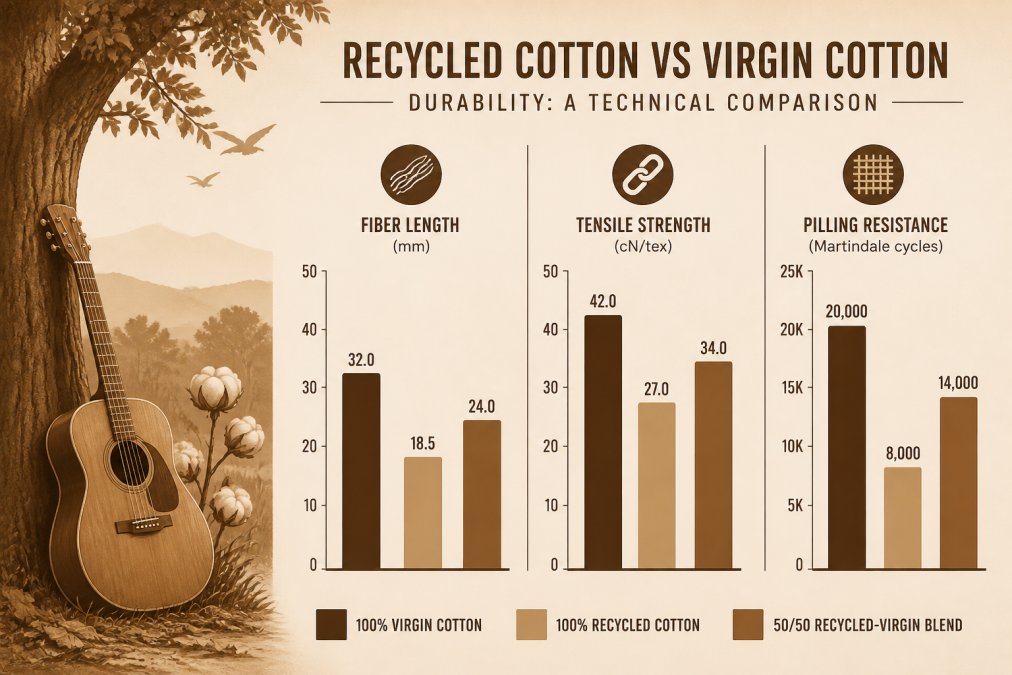
| Material | Fiber Length | Tensile Strength | Pilling Resistance | Best For |
|---|---|---|---|---|
| 100% virgin cotton | Long staple | Highest | High | Heavy daily wear |
| 100% recycled cotton | Short staple | Lowest | Low | Low-abrasion items |
| 50/50 blend | Medium staple | Near-virgin | Medium-high | Everyday t-shirts |
| Recycled + recycled polyester | Mixed | High | High | Activewear, workwear |
Durable Eco-Friendly T-Shirts for Everyday: What to Look For
Durable eco-friendly t-shirts for everyday wear share a few specifications worth checking before purchase. Look for a stated blend ratio, a fabric weight of at least 5 oz per square yard, and a certification such as the Global Recycled Standard (GRS) that verifies recycled content claims. Heavier fabric and a defined blend do more for garment longevity than any single fiber source.
Practical checklist for evaluating a recycled cotton tee:
- Blend ratio stated on the label or product page
- Fabric weight of 5 oz/yd² or higher for daily wear
- GRS or equivalent certification for recycled content
- Ring-spun or combed yarn rather than open-end, where disclosed
- Care instructions included with the product
- Reinforced shoulder seams and double-stitched hems
Construction details matter as much as fiber. A 50/50 blend with reinforced seams will outlast a 100% recycled tee with single stitching, even though the fiber content looks more impressive on paper.
How to Care for Recycled Cotton Garments
How to care for recycled cotton garments determines how long they last, and the routine is not complicated. Wash cold, turn the garment inside out, skip the dryer, and let it air dry flat. Heat and agitation are what break down shortened fibers fastest, so controlling both extends garment longevity considerably.
The 50-Wash Test: Recycled vs. Virgin Longevity
Most durability claims focus on new garments, but the real test is what happens after repeated washing. Consumer studies and textile lab reports show that 100% mechanically recycled cotton t-shirts typically develop visible pilling, thinning at stress points, and seam wear after 30-40 wash cycles. Virgin cotton tees often maintain structural integrity past 50 cycles. A 50/50 recycled-virgin blend usually reaches 45-50 cycles before showing comparable wear.
These numbers shift with fabric weight, yarn type, and care routine, but the pattern is consistent: blending extends lifespan. Heavier fabrics (5 oz/yd² or more) and ring-spun yarns resist degradation longer than lightweight open-end yarns.
A Wash Routine That Adds Years
When to Repair vs. Replace
Environmental Impact and Cost Considerations
Frequently Asked Questions
Is recycled cotton as durable as virgin cotton?
Recycled cotton durability is generally lower than virgin cotton because mechanical recycling shortens fibers, reducing tensile strength. However, modern blending techniques that combine recycled fibers with virgin cotton or synthetic fibers can produce fabrics with comparable durability for everyday wear. The key is the blend ratio and yarn spinning quality, not just the fiber source.
How does fiber length affect recycled cotton fabric strength?
Fiber length directly determines yarn strength. Mechanical recycling breaks cotton into shorter staple lengths, which means fewer interlocking points when spun into yarn. Shorter fibers create weaker yarns that pill and wear faster. Blending recycled fibers with longer virgin cotton fibers compensates for this shortening and restores much of the lost tensile strength.
How should I care for recycled cotton garments to make them last?
Wash recycled cotton garments in cold water on a gentle cycle and air dry. Hot water and high heat accelerate fiber degradation and shrinkage. Turn garments inside out before washing to reduce surface abrasion, and avoid overloading the machine. These steps preserve fiber integrity and extend garment longevity significantly.
Does recycled cotton have microplastics?
Pure recycled cotton does not contain microplastics because cotton is a natural fiber. However, blended fabrics that mix recycled cotton with polyester or other synthetics can shed microplastics during washing. If avoiding microplastics is a priority, look for garments labeled 100% cotton or cotton blended only with other natural fibers like hemp or linen.